First Plant sales of SPRING


It felt like spring, and then it snowed… and then spring arrived again… and then this morning some more wet snow flakes. But it’s time.  Time to open the nursery for our first spring sales for perennial edible plants.

With the arctic hitting all time warm records for February with temperatures ABOVE freezing and  there is still no day light…is just nuts.  Climate change is here and it’s happening faster than even the worst case scenarios.  But what can we do?  Planting food producing hardy trees is a great step… you can’t go wrong with this.

Farm schedule for sales of perennial edible plants:

When: Every Saturday this spring starting March 3rd from 10am-2pm.

Where:  3295 Compton Road, East Highlands, Victoria, BC

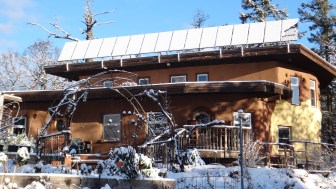
Details:  Even if you are not buying plants you can still come out to have a look at chickens, ducks, gardens, earthen architecture, the Eco-Hut, or to just hang out and have a conversation with other people.  If you don’t plan on buying plants, please park at the bottom of the hill and walk up.  Please do not bring dogs as they are upsetting for our ducks and our dog Nina will go into show-off mode and start racing around.  THANKS!

Parking is limited at top, so please park to make room for others beside you.

Discounts:  For purchases over $500 there is a 10% discount.  If you are planning a larger order you can also book a private appointment.  ann@eco-sense.ca or gord@eco-sense.ca

Plant list:  We have lots of new plants and many varieties of apples, plums, pears, cherries, walnuts, hazelnuts, currants, berries, hostas, persimmons, mulberries, chestnuts, apricots, nitrogen fixers, tea, kiwis, bamboo, grapes, peaches, Sichuan peppers, and many bare root plants.  All of our listed prices include GST.  Here’s our list:  

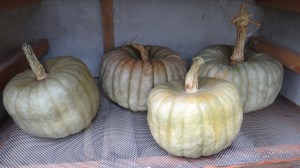
Queensland Blue winter squash – yummy and rich. Good baked, boiled, in soups, in loaves, and even in smoothies.

Other items:  We have some eggs, squash, garlic (for eating or planting), and cover crops (yellow and green peas).

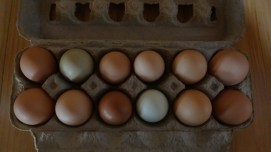
Eggs from heritage chickens…different sizes and different colours. Beautiful dark orange yolks.

See you on Saturday.

What’s Happening?


What’s happening at the Eco-Sense homestead?  LOTS!

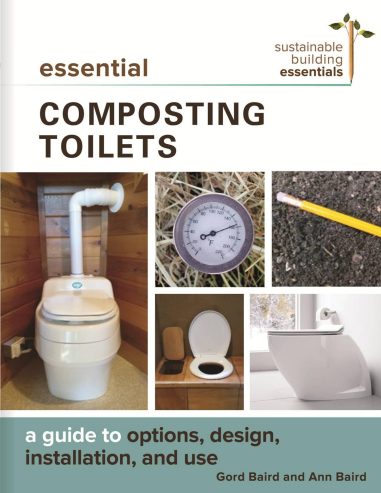
OUR FIRST BOOK.  We have been heads down most of the winter writing our first book; Essential Composting Toilets published by New Society Publishing.  A very timely topic given the rising awareness of water both locally and globally and the desire by many for increased resilience.  Writing a book is a HUGE time commitment that seriously restricts cash flow and many other basic tasks.  It’s a good thing we don’t actually have to buy much food.  Final manuscript is due mid March with publication happening a couple months later.

Cover Image emailed

The Eco-Sense Perennial Edible Plant nursery is scheduled to begin the spring season on Saturday March 3rd from 10am-2pm.  We had hoped to open sooner, but with the freezing weather, there is no point.  The nursery is well stocked with new plants that are just arriving.  We have brought in lots of large bare root trees as many people are planting larger trees to get their food production happening sooner rather than later.  Here’s our up to date plant list with prices…and remember all prices INCLUDE the 5% GST.

Our Friends Tayler, Solara and Flora have left Eco-Sense and moved to a walkable neighbourhood in the City where they operate their landscaping business Hatchet and Seed.  This move left us wondering…what to do with all that space?  We have come up with a creative solution.

Welcome to the…

MUDroom UNBOXED

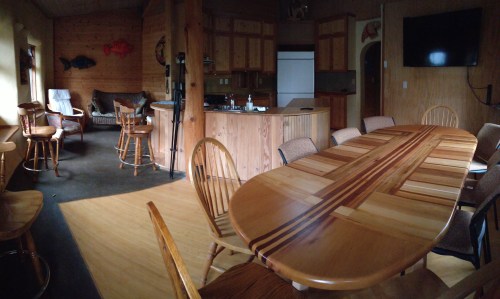
We have turned this beautiful space into an inspirational place for meetings, workshops, and presentations for RADICAL LEARNING.
Radicle LearningContact ann@eco-sense.ca for booking information.  Full details can be found on a new link on our blog.  https://eco-sense.ca/the-mud-room/.  

IMG_20180216_153058

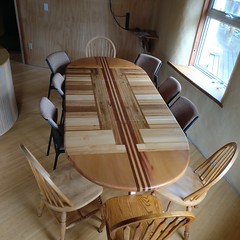
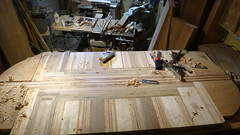
The MUD room with the gorgeous table that Gord built out of scraps of wood.  We can sit 10 people at the table or remove the table and set up seating for 15 to watch a video presentation.  Kitchen is well set up for food workshops.

Art Work:  Our cob walls are adorned with artwork created by the very talented David Baird (Gord’s Dad).  Gord has inherited his dad’s creativity.    Check out David Baird’s site here.  I continue to be blown away by the beauty and quality of his carvings.  All of the pieces displayed in the MUD room are for sale.


Please share this information with people in your networks who teach courses or give presentations and who may be looking for a unique and special place for RADICAL LEARNING.

Eco-Sense workshops: In the weeks ahead we will be posting a series of workshops and presentations.  Feel free to SHARE YOUR IDEAS with us.  Feedback is welcome.

Thanks.

That’s it for now.

DSC03052.JPG

Winter Lemons at Eco-Sense


Responding to the Urgency of Climate Change


Saanich Councillor Vic Derman sent his memo “Responding to Climate Change”, to Ann two weeks before he passed away in March 2017. I asked Vic if I could also use it in a submission to Highlands council with Highlands specific recommendations. He responded with “Please feel free to use the letter as the basis for what you submit to Highlands Council.”

At the time it was decided that Highlands would wait until it first appeared on the Saanich agenda and then go to Highlands. Then Vic unexpectedly passed away and everything was understandably on hold until after his life celebration. :(Then it was delayed for other reasons…then it was delayed until after the Saanich bi-election…then I decided to move forward with it as it had been 8 months since his passing. Vic wanted it out there and for his memo to be useful and inspire action. His memo to Saanich references the appendix he wrote for climate actions which is not yet a public document…That is for Saanich to make public and I hope they do.

23172615_1718622874823832_8981185412375149427_n

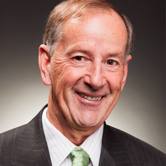
Saanich councillor Vic Derman Passed away in 2017

Given that his memo is now 8 months old and that myself and Councillor Gord Baird were using it as an introduction for specific recommendations here in the Highlands in our own memo, we felt it was prudent to run Vic’s memo by a climate scientist for “informal review”.
There were four edits to the text which are highlighted in RED below. The most significant change was in paragraph four where Sea Level Rise (SLR) is discussed. Vic originally said that a near 3m SLR could result by 2050-2060 and this was changed to end of the century. 3 meters by 2050-2060 is not fully supported by the scientific literature, however, it it discussed by climate experts as within the realm of possible. We thought it would be prudent to stick with more generally accepted numbers which are already catastrophic as we are currently witnessing.

RATIONALE

Climate change poses an ever growing, potentially critical, threat to human society and all species on our planet.  At the climate change talks in Paris, politicians established an ideal goal of staying under 1.5 degrees C rise in global temperature and recognized that, at an absolute maximum, global temperature rise should be kept under 2 degrees C rise. While laudable, these goals are not realistic without a very dramatic acceleration of our efforts to reduce greenhouse gas (GHG) emissions.

Last fall, the CRD held a Forum of Councils on climate change. Several knowledgeable climate experts confirmed that we have already put enough carbon in the atmosphere to guarantee a 1.6 C rise, likely in under two decades.  This means that limiting temperature rise to 1.5 would require sucking massive amounts of carbon out of the atmosphere. Doing so would be very expensive, if it could be accomplished at all.

Furthermore, as we move to the 1.6 C increase, natural feedback loops such as methane release from melting permafrost will contribute at least an additional .3 C rise. A recent article in the journal Nature indicates that the contribution of these natural feedback loops may have been underestimated. To sum up, we are, very likely, already effectively committed to a rise of 1.9 degrees or more, very close to, or beyond, the 2 degree C absolute maximum. Best estimates suggest that accomplishing the GHG mitigation commitments established in Paris, which most nations are not yet on track to do, would result in an increase between 2.5 to 3.5 degrees C. That is very risky and very dangerous territory.

More rapid sea level rise is one, but only one, of the potential consequences we face if climate change is allowed to follow its current trajectory. A few years ago, generally accepted estimates indicated a maximum sea level rise by 2100 of about 33 centimetres or 1/3 of a metre. By 2015, these estimates had been revised to indicate a rise of about 1 metre. Recently, study of West Antarctic ice shelves revealed potential deterioration at a much more rapid pace than expected causing researchers to suggest sea level rise of 2 – 3 metres by century’s end. (Vic is referring to this study http://www.nature.com/nature/journal/v531/n7596/full/nature17145.html)  A three metre rise, would be catastrophic and would eliminate, or put at severe risk, many trillions of dollars of assets.Protecting them would be extremely expensive if it were possible at all. Concurrently, society would face a huge influx of “sea rise refugees” as low lying coastal areas were inundated or became otherwise unlivable.

Even if a 2 – 3 metre sea level rise occurs less quickly, severe environmental damage will almost certainly result from a temperature rise exceeding 2 degrees C. Unwisely, we are doing substantial damage to our planet’s life support systems. Equally alarming are the potential fiscal and social impacts. A recent article suggests that attempts to control ocean albedo and “save” the arctic by using technology to “re-freeze” could cost about $5 trillion. This is an enormous amount of money, but is only a small part of the economic costs of responding inadequately to climate change. It is completely false to suggest that we cannot afford to respond to climate change. Instead, it is clear that we cannot afford to not respond.

As to social consequences, a society with hundreds of millions of refugees that also faces problems such as substantially “re-working” agriculture is unlikely to be stable. Unfortunately, it is much more likely to be modelled on the four horsemen of the apocalypse. It is difficult to believe that we would allow such an outcome to happen.

We are severely mortgaging the future of today’s children and those who follow. I doubt any of us would consciously choose to deny these children hope for a decent future but that’s exactly the consequence of our failure to adequately respond. We need the kind of massive, focused effort that society demonstrated in World War II, if we are to having any hope of avoiding the worst that climate change has to offer. Without question, there is a need for much greater action on the part of federal and provincial governments. However, collectively, actions of individual cities and municipalities are at least as important. Hopefully, Saanich and its Council will become true leaders in the massive, focused effort needed in response to the challenge we face. The time we have to respond is becoming very short.

RECOMMENDATIONS

  1. That Council commit to much more aggressively reducing GHG emissions (At least 80% reduction by 2040) and commit to establishing clear targets and “milestones” necessary to insure such a commitment is accomplished.
  2. That Council consider adopting the need to respond aggressively to climate change as the #1 priority in its strategic planning and that Council then work with staff to establish a climate change lens that insures decisions will be shaped by that priority.
  3. That Council direct staff to design and present to council a program of actions necessary to accomplish Council’s much more aggressive commitment, targets and milestones. (A description of potential actions is included as appendices)
  4. That in an open letter, Council copy this report to the Prime Minister of Canada and the Premier of British Columbia as well as to other relevant federal and provincial politicians along with a very strongly worded request for much more aggressive, focused federal and provincial action.

Councillor Vic Derman


Below is the resulting memo from councillors Gord Baird and Ann Baird presented to Highlands council on Oct 16, 2017.   Link

Since Vic’s passing in March, the climate has continued to heat up with hurricanes, wild fires, and floods in a relentless and unprecedented scale.  Millions are displaced and traumatized, with entire islands obliterated, and many have died.  Many will never recover.  It has become a moral imperative to act.

Building upon Councillor Derman’s memo, and our recent participation at the Livable Cities Forum, we would like to suggest that Highlands council take the urgency of climate change very seriously.  Highlands is very well positioned with policy and tools to make decisions that reflect the extreme urgency of the climate situation.  Our Highlands Integrated Community Sustainability Plan (ICSP) has two excellent sustainability tools; the Decision Making Framework DMF (page 24) and the Appraisal Form (AF).

 Sustainable Highlands Decision Making Framework (DMF):  Currently we have policy  II-110 requiring the DMF to “be used to analyze operational plan items brought forward from council’s approved Strategic Priorities” AND the two page DMF states right at the top that this tool can be used “to help assess any type of action, (plan, action, project, research, procurement, practice new or old) by using the Sustainable Highlands sustainability framework to inform decision making.”

Highlands Sustainability Appraisal Form (AF):  Currently we have Policy V-3506 that requires “all rezoning/OCP amendment applications be required to fill out…” and this form “may be used in other instances.”

The red highlighted text explains where these tools can be additionally used with no need to change our existing policies.  We suggest that: 

  1. Council members (and staff) look for opportunities to utilize these tools to better inform decisions that are deemed to have significant mitigation and adaptation implications.
  2. Council considers forwarding items of significant climate mitigation and adaptation implications to SSSC and/or SLUSC to gather more perspectives when utilizing these subjective tools.
  3. Council gives more weight to the information produced from the use of these tools when making decisions. 

Additionally, the following recommendations arise from the Livable Cities Forum that both Councillors Baird attended: 

Ann’s notes: http://www.highlands.ca/AgendaCenter/ViewFile/Item/3679?fileID=4328

Gord’s notes: http://www.highlands.ca/AgendaCenter/ViewFile/Item/3680?fileID=4329 

  1. That council direct staff to look into applying for a FCM grant to cover three integrated items and to report back to council with details, time frames, and costs if grant application is successful.  A new staff member dedicated to working with consultants on creating and implementing adaptation, mitigation, and resilience plans.  (FCM pays 80% Salary).  (Remaining 20% to be included in 2018 budget discussions).  Grant would also include funds to work towards the following:
    • Create an adaptation and mitigation plan including a risk assessment.
    • Commit to creating a policy stating these risks and what we realistically can and cannot do to mitigate these risks.
    • A full municipal natural asset initiative (MNAI) to begin in 2018/2019.
  2. That council direct staff to include a heading called Climate Change Implications in every staff report to council.  (This section could include any of risk/ adaptation/ mitigation implications, or ICSP tools as appropriate.  Even if staff leaves this section blank, this gives the opportunity for discussion at the council table.)
  3. That council direct staff to write a letter to South Island Prosperity Project (SIPP) indicating that Highlands will only continue membership in SIPP if the constitution is changed to include the wording “promoting local economic resilience through the opportunities arising from mitigating and adapting to climate change” AND that the ideas of working towards a circular economy are embedded in the vision for SIPP.  Council further directs staff to send this same letter to all the SIPP funding partners.
  4. That council direct staff to identify and bring back to council ongoing educational opportunities that strengthen corporate fluency and awareness of climate change, risks, adaptation, mitigation, and resiliency, for both staff and council.

Respectfully Submitted. 

Ann Baird, Councillor                                 Gord Baird, Councillor

It was an interesting discussion at the council table.  Recommendations 1 and 4 passed.  Item 2 was defeated.  Item 3 was changed to writing the letter to SIPP and funding partners but no mention of withdrawal from SIPP.


Nursery By Appointment Only


Hey Folks

Spring is almost here and the plant nursery is open starting Saturday March 3rd from 10am – 2pm, then every Saturday until end of May…

We are still making appointments for people to come to the nursery to buy plants or to book a tour.
Tour Rates

Lots of workshops planned this year at Eco-Sense as we ramp up our education offerings due to demand.

Here’s our nursery list

Contact Ann through the “CONTACT” tab.

THANKS

Cob Oven and Benches…take TWO


QUICK NOTICE for plant sales on Saturday Oct 7th from 10am-2pm.  It’s been a slow fall season at the nursery…mostly due to being TOO busy to properly market our plants.  (We are writing a book on compost toilets AND everything else we do) So…depending on how this goes on Saturday, this may be our last open house at the farm nursery until next spring.  However, we are always available year round for private appointments to come on out to buy some plants.  Send us an email at ann@eco-sense.ca or gord@eco-sense.ca to set up an appointment.

Cob OVEN and outside seating area.  In 2010, we built our Earth sheltered greenhouse out front of the house and the following year we built our cob oven into the north wall.


We created an outside patio and cob benches with a tiny living roof over the cob oven.  We used this area a lot while the kids were growing up enjoying many years of pizza, bread, and beans cooked in this oven.


These days, we are not eating much pizza or bread, but once and a while for a treat, we do enjoy a pizza.  If you would like to know why we don’t eat much sugar or simple carbs any more it’s because we have learned how unhealthy these are for our gut micro-biome.    Our bodies are simply not designed to have these foods as part of our regular diet…and who are we are argue with 200,000+ years of evolution and a few million before that.  Here’s the best book on the subject written by a geologist and a biologist.

“The Hidden Half of Nature” by David R. Montgomery and Anne Bikle. Basically, the rhizosphere (area around plant roots), and our colon are remarkably similar. They are both teeming with microscopic life in an amazing symbiotic dance sharing food, communicating, and playing a key role in health and immune function of plants and our own bodies. Both of these environments require lots of mulch. 

Good human health requires eating for your gut microbes. LOTS of fibre and very limited sugar or refined carbohydrates (like bread, pasta, etc). Your colon is your fermentation vessel where indigestible plant tissues are broken down by a very diverse community of microbes releasing metabolites that feed us essential nutrients (even serotonin), AND control the right amount of inflammation in our bodies…this is the control centre for our immune system. Our gut microbes release SCFA’s (short chain fatty acids), that are picked up by dendritic cells which them show these to the Tcells to control the amount of inflammation in our bodies and trigger the right immune response. It’s complicated, read the book to learn more about the scientific literature…and eat your veggies…lots of them.   

Gord and I now refer to dinner as “MULCH”, and our colon as our “indoor fermentation vessel”.  After reading this book, I came away with the thought that industrial agriculture with it’s microbe destroying chemicals and tilling practises are an unbelievably arrogant and stupid process.  To think that we can just decide to destroy the soil life and think everything will be ok…is simply INSANE.  The soil life is the basis of ALL terrestrial life…ours included.  So, if you are able, please don’t buy nutrient deficient crap food from this system.  The solution is EASY, support local, organic, and soil BUILDING methods of food production.  This is one of those action items that contributes to many positive things all at the same time.  Better health for you, more local jobs, better for the climate, better for biodiversity, better for farm animals and even better the ocean (no toxic run off).  

Back to the cob oven…The little roof just wasn’t enough… especially after this last winter with the very unusual freeze and thaw cycles.  Much of the plaster simply exploded.  So, we have redesigned it all and put a roof over it.  WOW…we love this new area…it’s so much more cozy and we have the addition of some outside tables for pizza preparation and for potlucks.

So rather than write a million words, here’s our photo journey of this project.  You can click on each photo to see more.


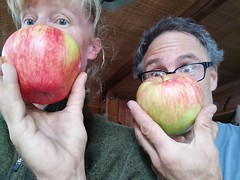
And so Gord does not feel left out of this post… sometimes, like today, we ate the un-hidden half of nature with our lunch.  Due to Ann not wearing her glasses… we supported our microbiome, (our colon cauldron) with the following vitamins A, P, H, I, D and S.    Sorry there is no photo journal of that.  Happy Thanksgiving.

Hope you enjoyed.

Ann and Gord