Regenerative Design: Food, Water, Energy, and Lifestyle


Free Time?

It has been a couple weeks since we closed the nursery for the season and some may wonder “what will Ann and Gord do with all that free time”?    Well, it allows us to focus on another aspect of what we love to do.  These past three weeks our time has been focused on some really wonderful projects within the region that draw upon our knowledge and passion around water systems, policy, food systems, and teaching.  Hmmm… where to begin?

Food Systems as Parkland

We are working with a local municipality to assist them in the creation of a park; a 1 acre fully planted food forest with integrated systems.   This public park addresses public accessibility, food producing perennial plants, water systems, education, beauty, carbon sequestration, habitat creation, and food security, to establish what we consider to be the first regional park that FULLY incorporates permaculture at a large scale.

Screen Shot 2016-07-01 at 11.01.04 AM

Artist Rendition – Conceptual Food Forest Park

Potentially  systems will incorporate storm water runnoff from roads  into large scale hugelkulture beds, dry planting zones, deer control methods from fencing to planting, living fences, high school student and community involvement, and education – just some of the areas covered in this project.  Diverting cars off roads by having a park and trail systems that are a more direct route to commercial areas, and thus drawing pedestrians and cyclists through the food forest and off the roads, as well as providing a park space for a new potential small scale community focused commercial development, all the while sequestering carbon in the landscape.   What am I missing… oh yes, about 1/3 of the municipal staff from planning, engineering, parks, public works, have dropped in here at Eco-Sense, and are seeing the concept  of INTERCONNECTED SYSTEMS as applied to food, water, energy, lifestyle… and some of our poor humour… and everything  else.    What an inspiring project to be asked to participate in.

High points of the municipal tours:

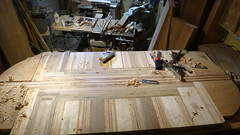
  • Engineers on each tour looking at Gord’s outside tables, checking the stability and then getting down to see how it is anchored to the ground
  • watching heads shake in disbelief while discussing the top-up of water cisterns using the cold well water diverting first through the house hydronic system, then to the cisterns to achieve air conditioning as part of irrigating crops.
  • watching the same heads shake in disbelief learning about the solar hot water heat dump used in food dehydration.
  • seeing staff that had already been through the day before, coming by again the second day, and enjoying plums off the trees at the end of June.
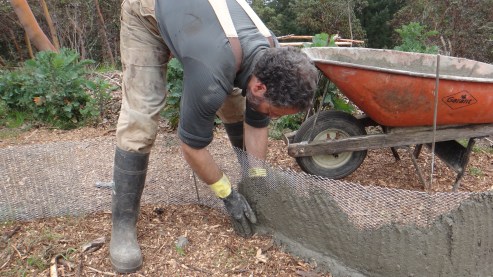
  • being asked if we would be willing to have some of their staff participate in creating the raised concrete curvy beds…  when we do our next batch in the next few weeks.DSC00515
  • finishing the last of two tours, on a day before the long weekend and getting another email at 3:59 pm to schedule one more tour for Mayor, some Council and more staff.
  • It is a pleasure to see an integrated  and cohesive group, and I keep meaning to compare their efforts of making a municipality run to how soil organisms make the plants grow.

Rainwater as Emergency Potable Water

Another local government has also engaged the services of Eco-Sense  in an effort to complete their existing but poorly functioning rainwater harvesting system and make it potable.  This would seem to be a fairly strait forward task ensuring that you store the water clean and then properly treat it to a potable water standard.    However, the initial design followed the  “silo effect” wherein it had been nicely done by an engineer, but without the understanding  of the bigger picture usage patterns and needs.

Rainwater Collection

Designing systems that are appropriate effective and resilient… as in  natural systems

This project was designed as post disaster assembly centre to serve many people where a UV system was installed to meet the potential demand of water flow for this rare situation.  The reality is that the office’s daily use is so vastly less that they can not create enough water flow to keep the UV sterilizers cool, causing the UV system to overheat and dump the water.   Consequently, the water is lost, water that is presently trucked in.    Not an efficient or resilient system.   In addition the system at 10,000  gallons (1/2 potable & 1/2 non-potable) is used to flush toilets and urinals – so in event of an emergency assembly during a disaster, the water would run out in a couple days as it would be consumed by flushing.  The foresight in planning has been exceptionally good by these folks, and again I am very pleased to even have the chance to watch how they continue to care for the community they serve.

The goal for this system:  Create a system where rainwater can be harvested, robustly pre-filtered and stored clean, reducing the need for trucked water, and during an emergency, water usage is diverted away from non-potable uses (flushing toilets) and treated for more pressing needs.  Perhaps composting toilets will be utilized as part of the emergency plan?

BC Ministry of Health (MOH) Manual of Composting Toilet and Grey Water Systems

Back in April the draft document was posted for public review.  Thank you to all that read the 135 pages of policy.  Ian Ralston took that information, updated the manual and presented the final draft to MOH.   Two weeks ago the MOH signed off on the document and we are just awaiting the legislation.    I am pleased to say that some of the requirements have been softened and are more in line with the science.

Aquifer Protection Development Permit Areas (DPA)

As a council here in the District of Highlands, we have been very concerned about protection of ground water quality and quantity.  Most Highlands residents use ground water from individual water wells.  Prior councils engaged a consultant several years ago to study our aquifers and report on their health and the impacts of climate change; the current council engaged the UVic Environmental Law Centre (ELC) to review the ground water reports, our municipal policies, and the new BC Water Sustainability Act; then we had our amazing Highlands Select Committees look at everything and make recommendations.

Screen Shot 2016-07-01 at 10.55.35 AM

Learning the Local Government Act

Now the next stage is to summarize the input and *hopefully* create a Development Permit Area that ensures that any land use must safegaurd the ground water, that contaminants do not flow into aquifers, and that all neighbouring properties to new developments have no negative impacts on their quality and quantity of ground water.  Gord is writing up a draft for Highlands council to consider and hopefully Highlands sets an Aquifer Protection DPA policy to fit community values. Potential failure?  Always a potential…especially as climate change is moving so much faster.

How fast is the Climate Changing?    Vic Derman, a long time Saanich Councillor and the Chair of the CRD Environmental Services Committee, wrote a report on climate change    that he presented 2 weeks ago.  Watch the video section starting at 5.4.  CRD Video

Rationale: In January 2016, CRD Board Chair Barb Desjardins asked the Environment Committee to provide a report detailing how the region should respond to climate change. The Board Chair’s request is opportune. Recent evidence suggests that climate change is accelerating and poses an ever growing, potentially critical, threat to human society and all species on our planet. Only three years ago, generally accepted estimates indicated a maximum sea level rise by 2100 of about 33 centimetres or 1/3 of a metre. By 2015, these estimates had been revised to indicate a rise of about 1 metre. Recently, study of the West Antarctic ice sheet revealed deterioration at a much more rapid pace than expected causing researchers to suggest sea level rise of 2 metres by century’s end. A subsequent review of this data by the National Oceanic and Atmospheric Administration, a U.S. governmental agency in the Department of Commerce, concluded that a near 3 metre rise could be expected, quite possibly by 2050 – 2060 as described in the following quote:
“. . . In a presentation at the Risk Management Society’s RIMS 2016 conference in San Diego April 12, a top scientific official with the National Oceanic and Atmospheric Administration said that recent, as-yet-unpublished data from Antarctica suggests that sea levels could rise three meters — almost ten feet — by the middle of the century. Margaret Davidson, NOAA’s senior advisor for coastal inundation and resilience science and services, told conference attendees that “the latest field data out of West Antarctic is kind of an OMG thing.” Davidson said that data shows sea level rise could reach three meters by 2050 or 2060, a much steeper rise happening far sooner than even the most catastrophic scenarios currently available in peer-reviewed journals and the far more conservative estimates published by the Intergovernmental Panel on Climate Change. That steep a rise in sea level would put significant parts of many California cities underwater in just two or three decades. . . .”
These projections have yet to be fully reviewed and accepted by the broader scientific community. Nevertheless, if correct, they suggest a catastrophic outcome if serious mitigation does not occur very quickly. Severe environmental damage would almost certainly result. Equally alarming are the potential fiscal and social impacts. A three metre rise would eliminate, or put at severe risk, hundreds of trillion dollars of assets. Protecting them would be extremely expensive if it were possible at all. Meanwhile, society would likely face hundreds of millions of “sea rise refugees” as low lying coastal areas were inundated or became otherwise unlivable. Another metric is equally alarming. Delegates at the recent Paris conference on climate change agreed that society cannot exceed an absolute maximum of 2 degrees Celsius (C) warming without risking run away climate change. However, the conference also agreed that keeping warming to 1.5 degrees C would better limit damage and provide a much greater margin of safety. Subsequently, a researcher at Concordia University created a “climate change clock” to indicate when these targets might be reached. His answer: Without a substantial increase in efforts to mitigate, 1.5 C will be reached in about 15 years (2031) with 2.0 degrees being reached in about 26 years (2042). These dates suggest very short time lines to accomplish the paradigm shift that all communities, including our own, may well face. To date, our responses to global warming could best be characterized as incremental and slow. Given the likelihood we are facing an increasingly urgent crisis, we must consider the need for an immediate and much more massive response.”
Here is a link worth checking out…it includes a short email between Margaret Davidson and Eric Rignot.  https://climatecrocks.com/2016/04/21/caution-new-sea-level-story-may-be-a-step-too-far/

So as nursery season closes, and Ann and I become bored with all our extra time (HaHa), desiccated by drought and loneliness from the closed nursery, we put on our other hats and dive into activities that wet our whistles and fill our vessels.


The End of the Spring Season *SALE*


This Saturday June 11, 2016 marks the end of our spring season for sales of perennial edible plants.  As most people know, the summer is not the best time to put perennial plants into the ground (unless they are babied in the warmer weather).

DSC02437Our farm business continues to be viable…financially, socially, and personally.  This marks the end of our third spring season, with sales rising every year.  Thank you everyone!  As noted the financial piece is only one way that we measure success.  Yes, our farm is financially viable, but just as important to us is that we make our permaculture homestead open to everyone to come by and visit and to simply look around on these nursery open house days.  People seem to really enjoy themselves and this makes us happy.  The final piece for us is that we enjoy the people that come to visit and the ensuing conversations about plants, life, philosophy and technical topics.  So it is with sadness that the spring season is ending, (Gord’s input – and excitement to be able to sleep in…)  however the fall season is only a few months away.
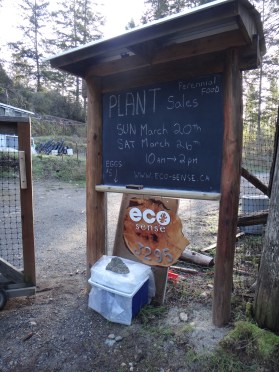
DSC02209Even though we are closed for the nursery in the summer we do make private bookings for plant sales ALL YEAR round for people who cannot make it to the scheduled Nursery hours.  But please note that these private nursery bookings are for the nursery only and not for free private tours.  If you would like to book a paid private tour over the summer, please send an email to ann@eco-sense.ca.  Two hour tours start at $200 for small groups of 1-5 people and go up to $275 for 20 people.
THIS WEEK AT THE NURSERY we have discounts on select plants…see below for items:  plant list here  (All prices include GST and Note: no credit cards – only cash, cheque, or on the spot email transfer)

TOONIES

  • Small strawberry plants…everbearing WITH strawberries…only $2 for a 4′ pot
  • some OCA plants left $2
  • Pepper and tomato and tomatillo plants – our extras in 4″ pots are for sale only $2 each.
  • Small comfrey (nibbled on by ducks).  $2

TENS (in 1 gallon pots)

  • grapes – various varieties
  • small Figs – Desert Kings
  • Thornless Blackberries
  • Hops in 1 gallon pots
  • Small Josta Berry
  • Russian Olive (not an olive – berry producing nitrogen fixing tree)
  • Echinacea – purple cone flower


DSC01915

Last years OCA patch – looks like clover.  The tubers are harvesting late in the fall – our favourite tuber.

TWENTIES (in 1 gallon pots)

  • Alaskan Blueberries
  • Dwarf Cherries (Valentin, Romeo, Juliet, cupid)
  • Small Goji (Firecracker and Dynamite)

We also have:  See our plant list here

  • a new batch of hard to find sweet potato slips for sale ($4 per slip).  Note that these amazing sweet tubers do extremely well in our climate but do require being grown in a very hot environment.  We grow them in a raised mound under a poly tunnel.  Our tubers have kept easily all through the winter.  This is the perfect time to plant them out.
  • A large variety of large fruit trees and some with fruit on them.  Many varieties of pears, plums, cherries, apples, apricots, almonds, FIGS, quince, paw paws, etc.
  • A large variety of berry bushes and some with fruit.  Currants (red, black, pink, white), Sea berries (seabuckthorn), goji’s, gooseberries, elderberries, saskatoons, haskaps (honey berries),  Josta berries, and more.
  • A large variety of vining fruit like thornless black berries, logan berries, kiwi’s (hardy, arctic, and fuzzy), grapes, etc.
  • Nuts:  Walnuts, pecans, almonds, chestnuts, yellow horn, etc.  Our new batch of blight resistant Hazelnuts is expected this fall (we ordered them 2 years ago).

The end of the spring season also brings a bit more time to our lives.  Add this to a reduced meeting schedule for July and August for our council duties and we will finally have time to get some incomplete projects done around the farmstead. (Ann’s input – No Gord … that means there is no sleeping in!)

Tour and Presentation season:  Starting this evening (June 8th) presentations start to ramp up with Gord’s presentation on all things water in East Sooke, then the Victoria Master Gardners’ tour on Sunday, Camosun Trade and Technical groups Monday and Tuesday… and later on the BCFTA (BC Fruit Testers Association).

Kudos to the RDN:  The RDN has created an “Aquifer Protection DPA” which set stringent requirements for both subdivisions and residential building.  LINK.  No subdivision or development activities may occur within the DPA without first obtaining a Development Permit from the RDN
SUBDIVISIONS:

  • must asses aquifer characteristics at the most stressed time of the year including cross sectional analysis of the aquifer;
  • perform a 72 hr pump down test;
  • assess ability of the aquifer to provide a sustainable water supply without impacting adjacent rural properties 
or agricultural activities;
  • identify recharge locations

RESIDENTIAL – All new dwelling units must include an external rainwater harvesting system which includes the following:

  • external equipment for collecting and distributing rainwater from the dwelling
    unit roof;
  • a storage tank(s) with a minimum storage capacity of 18,000 litres which is
    designed for rainwater collection and is rated for potable use;
  • a pumping system, an overflow handling system; and, the ability for future connection to the dwelling unit.

Thanks for reading and hope to see some of you on Saturday.

Ann and Gord


Building for Climate Change


Feeling grateful for the rain this week.  Our soils, with their abundant organic materials are soaking it up and holding onto it.  Anyone still interested in buying some perennial edible plants?  This milder wetter weather is still good for getting a few more perennial plants into the ground.  Come on out to Eco-Sense on Saturday June 4th from 10am – 2pm.  3295 compton road.  As sales have slowed down, we are thinking of this as being the second to last open house.

IMGP1223

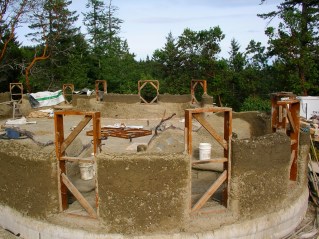
The start of MUD house building

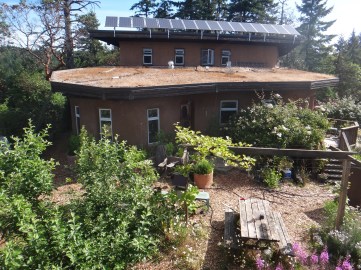
For those paying attention to climate change, the news is filled with no end of horrors for people and the planet which can be really tough to process, but on a more positive spin, we are very pleased with the performance of our cob home.  The two foot thick load bearing cob walls made out of MUD (Modern Utopian Dwelling), are performing exceptionally well in our warmer climate (as are our olives, almonds, lemons, ginger and apricots).  Not only are our walls engineered for earthquakes, but they are fireproof, and keep out the sounds of howling gales.  This house does not shake in a wind storm.  But even better than all of that is it has now been 3 months since we had our last fire in the wood gasifier, and even back in mid February, we were only having occasional fires to supplement the solar hot water.  In our home, we use solar hot water both for domestic use (showers and sinks), and also to heat the home through warm water pumped though pipes in the earthen floors.  We have had enough solar hot water production to provide for all of our hot water and heating requirements.  This of course supplements the passive solar heating we gain from building our cob home in the sun and our efficient building design.

Gord and solar HW

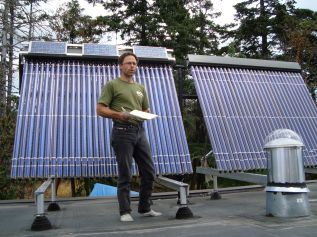
Gord teaching about Solar Hot Water

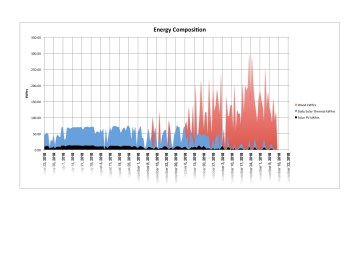
Some of our friends may remember that research study we did back in 2010/2011 with a grant from Vancity and the Real Estate Foundation.  We had all kinds of sensors in the walls and data loggers to monitor wall performance and energy use for one full calendar year.  It was the year when high tech met low tech to show how and why cob buildings can last for many centuries and how they perform from an energy perspective.


Energy Composition

Energy graph would be very different this year (black= solar PV; Blue = solar thermal; Red = wood)

Our home performed exceptionally well that year even though it technically has an r-value of only R-24 (now much higher).  This research was performed in a year that had unusually low solar insolation (9% LESS SUNLIGHT in a 12 month period than average – which mostly occurred in the shoulder seasons – Spring and Fall).  Here are the links to two of the research reports.   Eco-Sense and the future of Green Building – Affordable, Sustainable Homes  and the technical information with lots of graphs


DSC01874

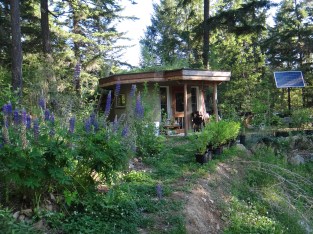
Eco-Hut – plant sales office and example of off-grid tiny home made with recycled materials, earthen plasters and finishing, blown in cellulose.

This all brings us to a new video series just released a couple days ago.  Four short mini documentaries on Earthen Architecture…it’s very well done, but we think they could also have included a fifth episode on earthen infill methods like “light clay” and cellulose (like our Eco-Hut).

Here’s the links to the videos.  Eco-Sense features in part one on Cob, and we have the last say at the end of episode 4.  Very inspiring videos.  https://groundworkseries.com

Here’s some quotes from others:

Pat Hennebury from Cob works referring to living in a cob house – “It’s like living in a hug”.

Meror Krayenhoff, SIREWALL rammed earth builder – “We’re willing to jog for cancer, but we’re going to paint our houses with carcinogenic paint. I’d like to think most people wouldn’t make those decisions if they knew all the toxic materials that are in their buildings, and the short life spans. Why don’t we have a building code that all houses must be healthy; no carcinogens, no pthalates, has to last 200 years (min.) and be net zero energy. If we could get all the housing in Canada to be net zero and have to last for 100s of years, we’d be so far ahead of every other nation. I would assert that the logical, reasonable way forward in dealing with cancer is to address the cause, not the symptom.”

Tweaking:  As noted above, the insulative value of the house is much higher now, as we took data from our research and plugged the weak spots.  Hence the north wall was studded out and blown cellulose applied turning the otherwise R-8 wall into R-40.  Without testing, we suspect we now run at an effective R-30 for the whole house as a unit.

Another tweak, in the effort to just be nerds, was to figure how to cool the house in summer.  During irrigation season our rain water storage gets used up, and we then slowly top up our irrigation tanks from the well.  The well water is about 6-7 C.  As we designed our hydronics to handle an open loop (choosing appropriate pumps and materials that don’t oxidize), we flush out the hydronics at the start of the season,and re-route the irrigation top-up.   Each evening the well top up has to run through the earthen floors enroute to the storage cisterns, thus cooling the house.  Precautions  in place with proper double check valves.  If we were to re-design the house, we would have installed a parallel set of potable water tubing alongside the hydronic tubing when we installed the floors.

Baird council initiative of the week:  Where to begin…lots going on.

Ann:  To read Ann’s update to Highlands council on these topics click here:

  • Attended the CRD Climate Action Inter-Municipal Steering committee.  Lots of discussion on sea level rise and I discussed the presentation to Highlands council by Deborah Harford (Executive director of SFU’s ACT – Adaptation to Climate Change Team) – Other municipalities are also looking into having a similar presentation.
  • Private meeting with the new executive director for SIPP (South Island Prosperity Project) and a new board member to discuss Highlands perspectives of what we would like to see for economic development in the region.

Council Failure of the week:  Nothing this week… and like the last time this happened, we noted were were not trying hard enough.

Update on Broom composting project for our community:  As readers may be aware, we initiated a project to take broom and gorse collected from the Highlands Broom bash, where volunteers clip the broom in bloom, bring it back to the Community  Hall site, chip it (with thanks to Colin O’Hare and his company Sky View Tree Care).    After chipping, we allow to sit for two months, then bring in a little horse manure and do what we do best… stir the Sh*t.   Four months later we have the most amazing spongy and moist material we have ever come across.


The final intended use of this material is for the community gardens that will be developed on this same site in about 1 years time.  That is full circle, taking an invasive species that is one of our largest fuel sources for wildfire, that when harvested and composted is a huge source of potassium and phosphorous, and a major moisture retention media, and using it to grow food for the community.  That’s more than just Fire Smart.  What a way to end an update.

All the best,   Ann and Gord

Working on the Front Yard


DSC01942

We are finishing off zone 1:  For those not familiar with permaculture zones, zone 1 refers to the growing and living area just outside our doors and closest to our homes.  This is prime real estate for beauty and function.  (Gord almost meets these criteria, therefore he is only a transient part of zone 1 for a few weeks).    We have already utilized most of this area over the last 10 years, but the final piece is the area in front of the cob house between the two front doors that used to be occupied by an enormous and dangerous rose bush.  This area gets smoking HOT in the summer and even gets full sun in the winter.  Absolutely ideal for creating micro climates for perennial and annual plants that like it hot and also like winter protection AND for growing winter greens.  We spend the most of our ‘relaxing’ time in zone 1, so it makes sense to create more beauty and food to nourish our bodies and our minds.

DSC02442.JPG

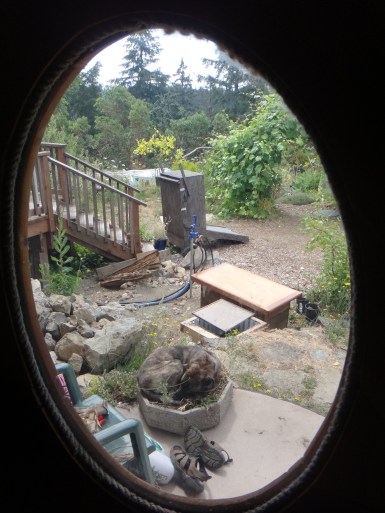
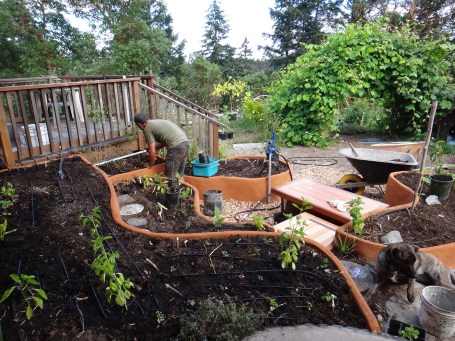
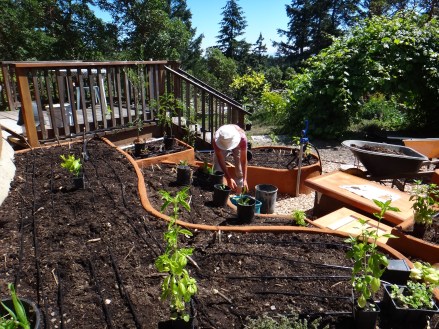
Remove the rose bush and dismant the rock work around the well.  Build a proper well cover and build a sitting bench to shade and protect propane tanks and also contain winterized irrigation connections.  Then we can design and build new raised curvy beds.

Nursery: Open from 10am – 2pm SATURDAY May 28th.  3295 Compton Road.  Email for private appointment.  (gord@eco-sense.ca or ann@eco-sense.ca)

Great deals on small items:

  • We have potted strawberries ($2)
  • Oca plants ($3)
  • Asparagus (singles in 1 gal pots – $3)
  • A few HEALTHY heritage tomato plants (1 gal pots – $5 and 4″ pots – $3)
  • Pepper plants (4″ pots $3 – 4 types)

Sale Items:

  • NATIVE PLANTS ON SALE FOR THE REST OF THE SPRING SEASON:  30% off
    • Labrador Tea, Sweet Gale, Alaskan Blueberry, Alder, Willow, Garry Oak, Maple, Oregon Grape, Lingon Berry, Nodding Onion, Salmon Berry, Yarrow.
  • 10% off of select plants  – Comfey, Grapes, Sweet Grass and others – for the rest of the Spring season (this means less plants for us to look after all summer).

Eco-Sense Video of the Week:  School of Permaculture filmed Gord last summer showing how we dry food with water.  Here’s the 3 minute video:  

DSC00513Eco-Sense Photo from the Past:
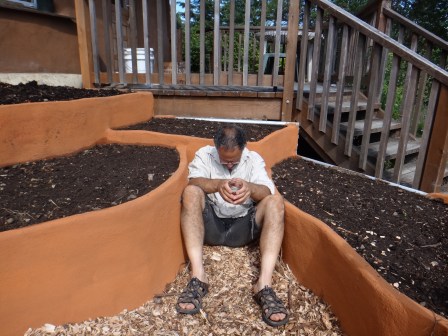
Building our first Curvy Bed

DSC02424

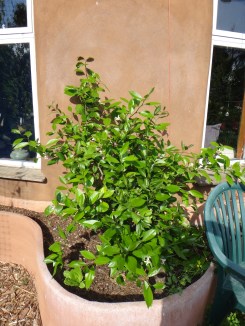
Lemon tree covered with new blossoms.  Curvey Beds at front of house create amazing micro climates.

Gord’s thoughts and rants: He’s tired of people that get labeled environmentalists!

It is clear there are only two groups of people out there in the  “real” world. The “Forces of No, leaf licking, socialist, environmentalist types”, and the rest of the sane world.

When CBC reports on this pipeline or that dam, and those who are against it, they unconditionally ALWAYS regard those who oppose it as environmentalists. My question is who are those environmentalists?  Who are the real people who oppose mines, dams, pipelines, and toxic crap?

If you are a Mom and your groundwater  fed kitchen tap now catches fire and your kids can’t drink it due to fracking… does it make you an environmentalist to oppose the fracking industry?

If you are a farmer and your best fields are about to be flooded, and you oppose a dam… does that make you an environmentalist?

If you are a forester and your working window is curtailed due to earlier closures in the season, and for longer periods, and you have concerns of the climate impacting your living… does that make you an environmentalist?

If you pull your drinking water from the ground and

  • the neighbouring golf course uses glyphosate and fertilizers and makes your water no longer safe… does that count?
  • The province allows a toxic mine in your water shed and risks your drinking water… does that count?

What if your culture, your community, or those who have relied on shellfish, can no longer harvest because of sewage outfall… oil spill… mine tailing contamination… ocean acidification and soft shells, does your opposition make you an environmentalist?

What if you are a researcher and are studying mass extinction and species collapse… or you live on low lying islands that are being hammered by storms and swallowed by the seas… or a farmer that has not seen rain in four years, does that make you an environmentalist?

Please explain, as obviously I do not understand. This past week in the news we have seen the media report on the Kinder Morgan approval, and watched Brad Wall (premier of Saskatchewan), apparently dismiss the same science he relies on for his communications, transportation, and health care. Those damn environmentalists… those damn “Forces of NO”.  For reference, Brad Wall referred to climate science as “some misguided dogma that has no basis in reality.”

Here is an excerpt from a person on Facebook to Gord in reference to the discussion on Brad Wall’s throne speech. The response placed in context was a person who spent two years to get the OK and funding to build an outside public flush toilet, and had a single conversation with Brad Wall, and thus confirmed without a shadow of a doubt that Mr. Wall was a nice person and I should just send him a letter stating my concern. (WARNING… foul language).   (Paul from Duncan): “You live in your world while the rest of us live in the real world stop your whining and complaining and do something about it it took me 2 years and I got something done instead of living in the stone age welfare socialism selfserving crap you enjoy because of the world you don’t like kiss my hard working tax paying ass.”

Why does our culture simplify the issue into Us and Them… the real world folks and then the  “environmentalists” (or otherwise Moms and Dads, foresters, farmers, First Nations, scientists, fisherman, neighbours).  To the CBC: Why run from the complexity, why not actually take your responsibility as a public media source and properly and clearly frame the issue rather than be lazy and dumb it down?

Next time you hear the news report on something and refer to the environmentalists… think about that…think about what that really means.  How about every time you hear the word “environmentalists”, just substitute the word “people” and see what happens.

Gord and Ann


Where’s the rain?


DSC02433We miss you rain.  This spring has been record breaking dry…and record breaking warm…and record breaking fires…and record breaking loss of arctic ice…and record breaking CO2…and record breaking stupid (The throne speech in Saskatchewan comes to mind).   Please come rain, and wash away our records… wash away our tears.

DSC02425

Honey bee enjoying a lemon blossom

However, in spite of all the heartbreaking negative news, we carry on doing what we do and finding our sense of humour with how ridiculous the world is becoming…like Gord coming home from the hardware store and posting this on Facebook:  I walked into Rona yesterday and turned to my right to see pallets (4 or more) full of spray bottles of Roundup stacked and advertised like junk food at the check out. The sheer enormity of the volume of poison I was walking past made me shudder and I verbally swore “fuck” and shook my head… I am sure the person beside me thought I was nuts.  Just another example of human beings exterminating themselves with known carcinogens.
Anyways, here’s what we have been up to:

  • DSC02421new projects in the garden and on the land (photos below)
  • Saturday open house for sales of perennial edible plants.  WOW, are we ever meeting some amazing people that are coming out to visit and buy some plants.
    • Sat May 21, 2016 from 10am -2pm.  3295 Compton Road, East Highlands, Victoria.  
  • Gardening: Planting, weeding, mulching, watering, picking, drying, and EATING
    • celebrating our local food with every tasty mouthful.
  • Chickens and Ducks and 5 chicks and 1 duckling
  • Council meetings, committee meetings, and more meetings.
  • Tours and consulting
  • Ranting on Facebook and sharing information

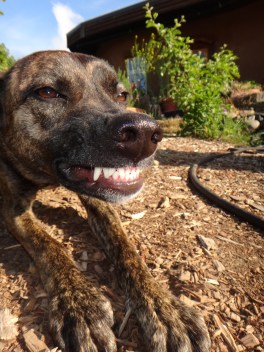
DSC02437We are grateful to our land and feel so incredibly lucky to share this land with all the birds, and insects, mammals, amphibians, reptiles, plants and fungi…but we could do without all those ticks.  We are also grateful for our smiling dog Nina…yes this is a smile…she always gives us a toothy grin when happy.

Newest project:  Gord has built a cover over our cob seating area with the cob oven.  We will be making this seating area smaller and cozier with a roof to protect from the sun and the rain.  The photos show how Gord installed the two posts to support the roof, this is a process he uses a lot on fences, trellises and gazebos.


Gord’s political observations of local government officials:  

Political Chameleon

DSC02427

Hardy Kiwi – shading the western side of the house AND producing LOTS of fruit.

It has been 1 1/2 years since we jumped into the political game… Yes – both of us.  On the outside of the system we were driven by injustice and inaction and took the plunge with the hopes of helping create a more resilient and adaptive community.  Our general view at the outset was less than stellar of political folks, thinking that many must get into the game for purposes outside of community service.  We are glad to see we had misconceptions, as most local elected officials we are meeting are genuine and caring people, working for the best interests of their community.  Many of these people share vastly different points of view than we do, but the key here is that they care and are genuine.  

That said there are others out there that we have come to see as chameleons and motived by other forces.  Folks whom may very well publicly share our views, but act very differently when away from the public eye.  Our respect for some has more than evaporated.  We have been attacked by some as being unrealistic when we speak to the elephant in the room around growth and climate change, we have seen some twist David Suzuki’s concept of the “right to clean water”  (under his Rights to Nature initiative) co-opted as the “right to piped water”… and then this person attacks those that see the issue as an environmental “right” to clean water in lakes, aquifers, wells, watersheds, and rainwater.  We have witnessed some withhold information from their council and not allow their councils to interact with municipal staff.  We have also witnessed the pull of financial interests, and too often some that are not prepared for meetings.  But thankfully I can only count those folks on one hand, and am so grateful that our own community of the Highlands does not have any of that going on.

Our council table is generally characterized as diverse, highly intelligent, with different perspectives, and an amazing amount of integrity and genuine care for the community.  I thank each and every one for that, and, for being a model that other councils/councillors in the CRD enquire about.  Metchosin has the same thing going on… an impressive example of a great functioning political system that allows for different points of views and genuine respect for one another… and pride.

I am proud to be on the Highlands Council.  Very proud.

DSC02403

Apricot trees for sale

Disclosure:  So it appears that Councillors Gord Baird and Ann Baird are in a financial conflict of interest with the District of Highlands.  HA.  Last council meeting we both had to leave the room while council disclosed to the public that Eco-Sense (Ann and Gord), hold the contract for cleaning the public bathroom – A composting toilet in a small cob building at the local swimming lake.  All is now good…we can clean the bathroom with our financial secret fully disclosed in a public meeting.  Here’s the link to the council report stating how filthy rich we are getting.  

There it is… short and sweet.  Thanks for reading,

Ann and Gord