Chestnuts – feature plant for Sat May 17 open house


Our weekly farm gate open house this saturday (May 17th from 10am-2pm) features Chestnuts.  (open house details)  We believe that chestnuts will be an essential perennial food plant in the decades to come.

cropped-dsc00433.jpg

With climate change causing global disruption to food production, perennial foods just make sense.  Perennial plants like chestnuts, hold the soil together year round, and are more drought and heat tolerant.  PLUS, chestnuts can be ground into flours to make all kinds of nutritious foods without gluten and they even feed livestock.  Large food producing trees also sequester large amounts of carbon in the tree and the soil.  So whether you are concerned about local food, a healthier diet with less grains, mitigation of climate change, or adaptation to a changing climate, perennial plants are for you.

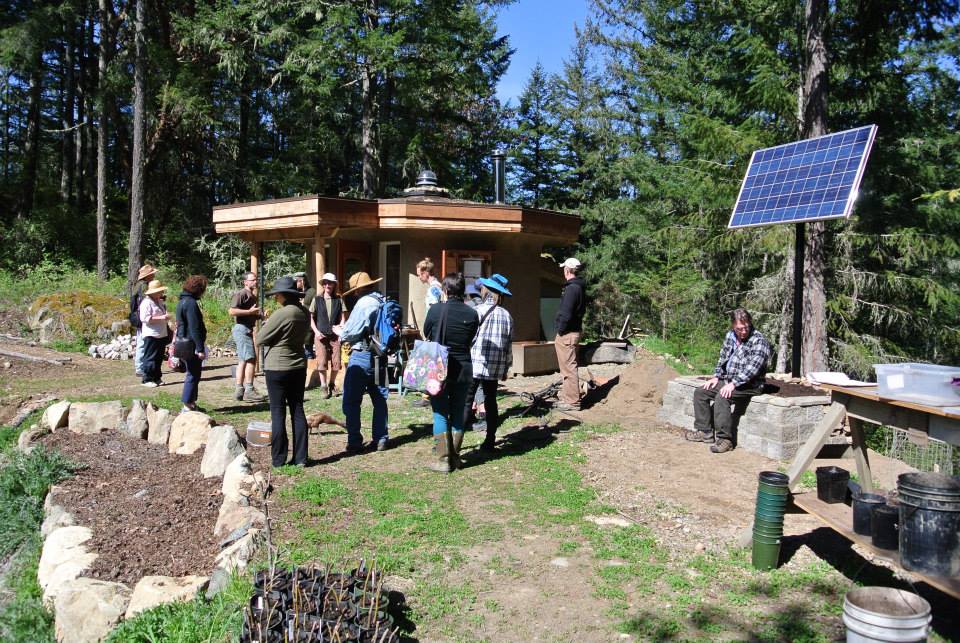
Tour group in front of Eco-Hut (office for farm business)

Tour group in front of Eco-Hut (office for farm business)

Come on out to Eco-Sense this saturday and have a visit, talk, walk, learn and even share your favourite rants.
We have chickens and ducks so please leave your pets at home.

Ann and Gord


Chestnuts – Castanea spp
– Chinese Chestnut – Castanea mollissima
– Japanese Chestnut – Castanea crenata
– American Chestnut X – Castanea dentata
– European Chestnut X – Castanea sativa

Why Chestnuts?

Chestnuts are the replacement for grain crops, are perennial, heavy producers of nutrient dense food for humans, wildlife, and farm animals alike.  Considered the most important tree in temperate climates, and the topic of many books including Tree Crops: A Permanent Agriculture by J.R. Smith which was one of the pivotal  books that spawned Bill Mollison’s permaculture revolution.

American Chestnut - WOW!

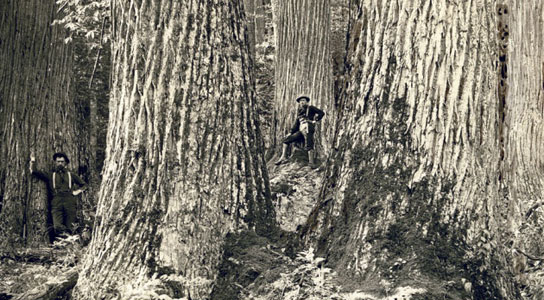
American Chestnut – WOW!

In North America the giant American Chestnut (Castanea dentata), (100 ft tall, 10 ft diameter trunks), was the most valuable crop due to the shear quantities of reliable food it produced, and the exceptionally rot resistant wood it produced. In the early 1900s chestnut blight was introduced and heavily impacted the orchards – the die off was massive. In true human fashion, rather than protect the surviving chestnuts which may have been the genetically resistant version of the American chestnut trees, there was a huge push to chop them all down and harvest the wood before they went extinct, as is done in good human fashion.   This virtually eliminated any chance of bringing the American Chestnut back.

Chinese Chestnut 40 feet


Japanese Chestnut – 20 feet tall

The Chinese Chestnut (Castanea mollissima) had evolved with the blight and had natural tolerances, and has since become the most widely planted chestnut in North America. The Chinese Chestnut has been used to cross with C. dentata to breed a cross that is blight resistant.   The Chinese chestnut is about half the size of the American chestnut growing to 40 ft tall, multi stemmed, has larger nuts, is suited for drier rockier soils than the Japanese chestnut.

The Japanese Chestnut (Castanea crenata), also with resistance to blight is being is also being used as a breeding stock to build immune resistance into the American chestnut. The Japanese chestnut is the smallest, reaching heights of 30 feet, with a multi stemmed growth habit, and has been known to have the largest of the nuts (up to 40 g).

European chestnut - 60 ft

European chestnut – 60 ft

The European Chestnut (Castanea sativa) is large like the American chestnut, and highly edible. It shares all the similar benefits as the others. We believe our crosses from Gabriola Island and Fernwood are C. sativa crossed with Chinese… but we will observe growth habits and leaves.

Growth

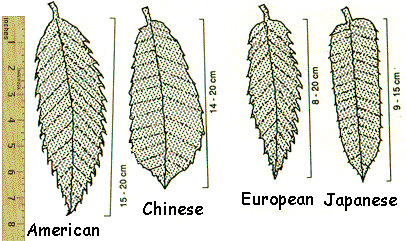
Hardy from zones 5-8, all will need a start in moist well drained loamy soils, though once established the Japanese and Chinese will handle dry conditions well, and the Chinese can handle rockier soils. Nut production should begin in 5-7 years, with heavy crops in 10-12 years.  LeafComparisons If planted in the sun, the tree will form more nuts, but if partially shaded, there will still be nuts, so we just planted more trees.   We are transforming areas over the next 10 years where as the chestnuts grow taller, we’ll harvest some of the surrounding taller trees to allow for the chestnut to become the dominant center piece.

Edible

Yes!   Nuts are a major food source for animals (including us silly humans). In comparison to other nuts they are low in calories, due to less fat, high in carbohydrates making them a good substuitute for grains for breads. They are high in folates (folic acid), 100 g has 72% of DRI of vitamin C, rich sources of oleic and palmitoleic acids (mono-unsaturated fatty acids). Further, they are also rich in many important B-complex groups of vitamins. 100 g of nuts provide 11% of niacin, 29% of pyridoxine (vitamin B-6), 100% of thiamin, and 12% of riboflavin.
Boiled, roasted, raw, as a flour, these are versatile.

Other uses

Wood of all cultivars is strong and long lasting. The leaves , bark and seed husks are high in tannin and can be used in tanning hides.


Saturday May 10th: Edible Perennial Plants at Eco-Sense featuring The Autumn Olive


Our 3rd open house of the season on Saturday from 10am-2pm:
Map
Eco-Sense
3295 Compton Road, Highlands, BC

Last Saturday we had another successful farm gate open house at Eco-Sense. Enthusiasm for perennial plants and local living is growing…almost faster than our food forest. People come to Eco-Sense to buy perennial food plants, eggs and seeds but ALSO to talk, walk, and learn.

We love that we are not just a nursery. We are a place to share stories, learn, connect, and feel inspired to put some permanent roots in the soil.

Also on Saturday is this very special workshop hosted by our good friends at Hatchet & Seed:  An awesome opportunity to learn about specific perennial plants.

Also on Saturday is this very special workshop hosted by our good friends at Hatchet & Seed: An awesome opportunity to learn about specific perennial plants.

People are coming and bringing their friends and family to stroll through our various gardens, peek at the cob house, the Eco-Hut, chicken coops, root cellar, and to socialize, hang out with chickens and ducklings, and to get ideas and share ideas.

For further details click here:  OPEN FARM DETAILS:

What fun! Thanks everyone!

Autumn Olive – Elaeagnus umbellata

Why Autumn Olive?

If you have never read about permaculture then you would never know why we consider this to be one of, if not the most, important plant we grow. This plant has many uses as a food source as well as a support plant for the fruit and nut trees and ground covers which means that we include many of these small trees.1326053669-eleagnus1_web

First off, lets just say the autumn olive is not a olive at all, but a fruit that looks like an olive, except yellow, orange and red. The fruits are delicious!   But not getting all anthropogenic and thinking about our taste buds (and health) this shrub is a nitrogen fixer for the soil.   Classified as a pioneering species, its role is to collect nitrogen from the air, suck it down to the roots where mycorhizzae (fungi) develop a transport system that takes that nitrogen and then feeds it to surrounding plants.   This means we do not need to bring in fertilizers to feed the other plants! We ultimately wish to have one plant for each of our various fruit and nut trees (this means upwards of 50).

Elaeagnus_umbellata_AutumnOlive_fruitsGrowth

This deciduous shrub grows 12 ft tall, hardy to -30C, and handles dappled shade to full sun.   We grow ours in the understory of our arbutus grove and in two areas that get full sun. We have found those in the dappled shade have grown quicker.

Edible

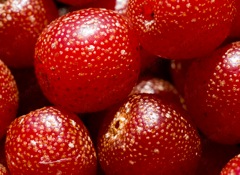
The berries!   Delicious and high in lycopenes, an intermediary in the creation of carotenoids, which integrate into the lymphatic system and both aid in reduced cancer (especially prostate) as well as increasing the resistance to skin damage by UV radiation .autumn olive berry closeup

Other uses

Nitrogen fixation for use by the other plants surrounding the autumn olive is one of the most important for us.   The flowers are a key insectiary attractant.  It was introduced to North America 100 years ago as a soil stabilizer for heavily impacted and damaged landscapes, and as it is a pioneering plant, it performed this job very well… some may say too well, but we can’t blame a plant for our own human invasiveness and land impacts – here we keep it in check by eating it… and the deer do too, (too bad scotch broom is not edible). It is also a key source for mulch during the growing season as its prunings are chopped and dropped and become mulch, as with the leaf drop in fall.

We have Garnet and Ruby cultivars, and by the end of next week will have Amber too!


Sat May 3rd Farm Gates Sales Open House (10am-2pm)


Keeping our Pawpaws off our nuts!

It’s SPRING at Eco-Sense,  and it started with a vibrant burst of activity on our first farm gate open house  (saturday April 26th), which was surprisingly more hectic than we imagined.   Over 40 people wandered through our specialized perennial food nursery and the hilltop gardens and trails like pollen floating and spreading on the breeze.    Our day was spent informing people of the details of the various plants, sharing Mud Puddle stories and cuddles, and  selling out of our eggs too!

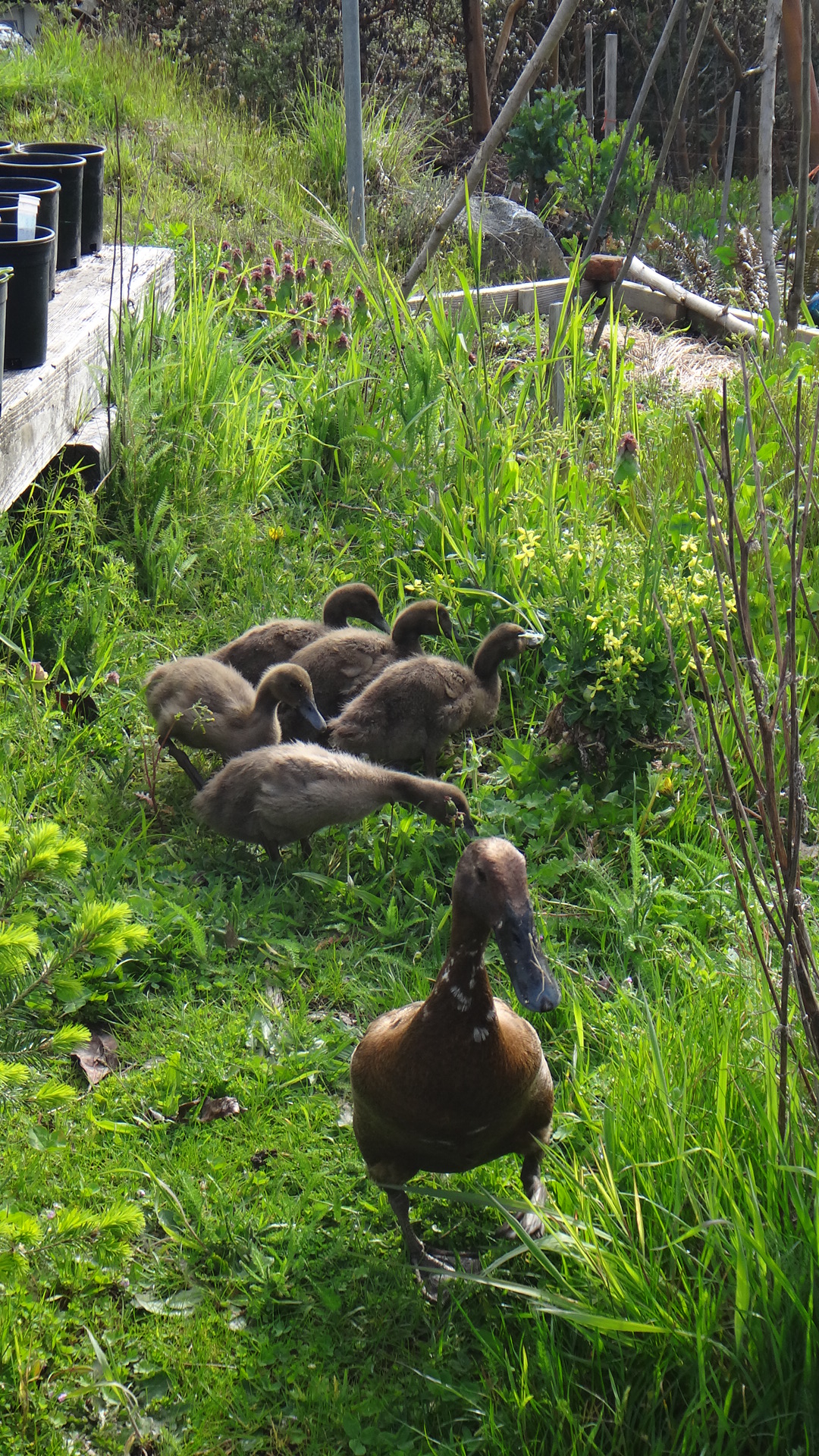
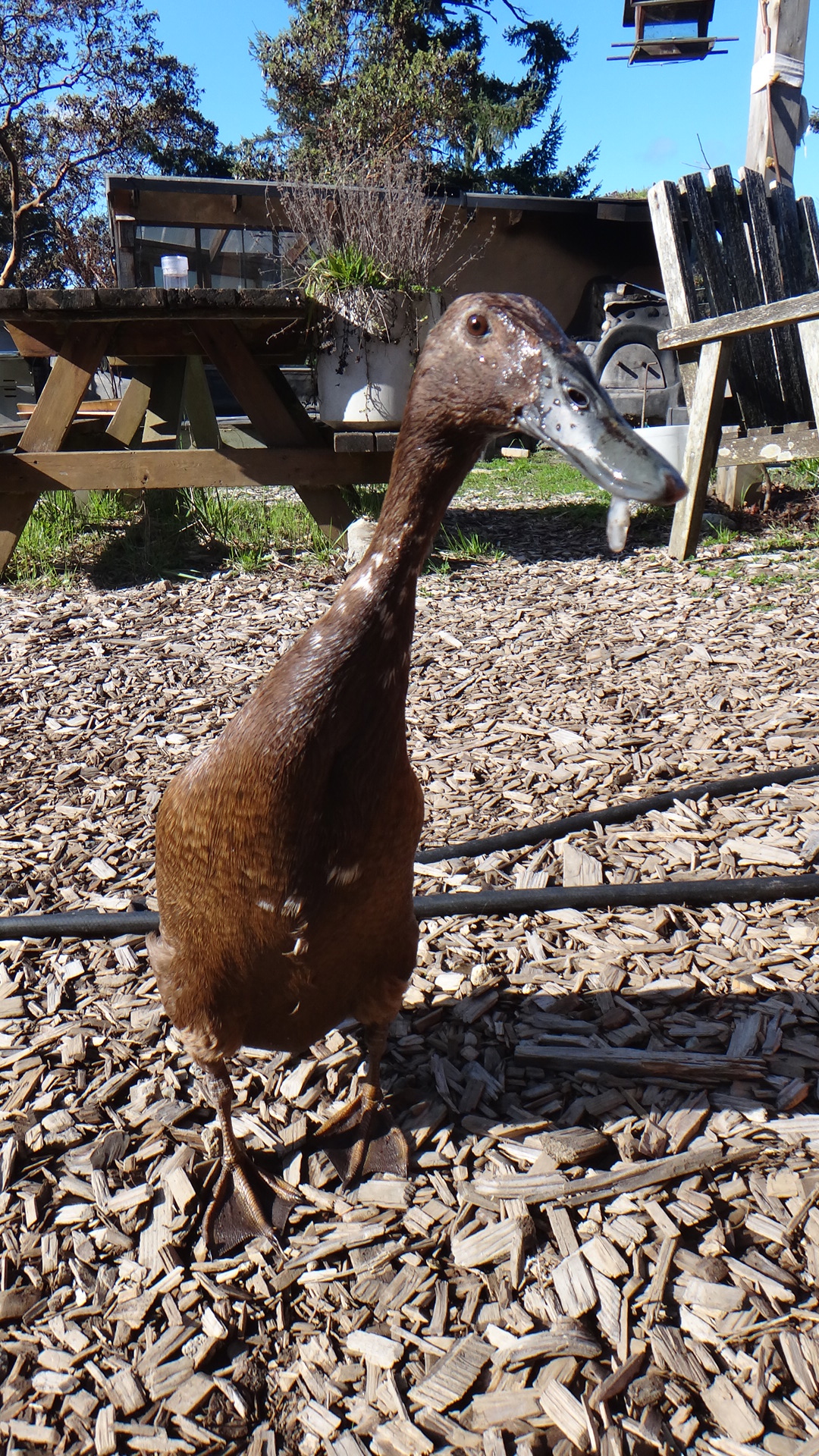
Mudpuddle the duck leading another tour

Mudpuddle the duck leading another tour

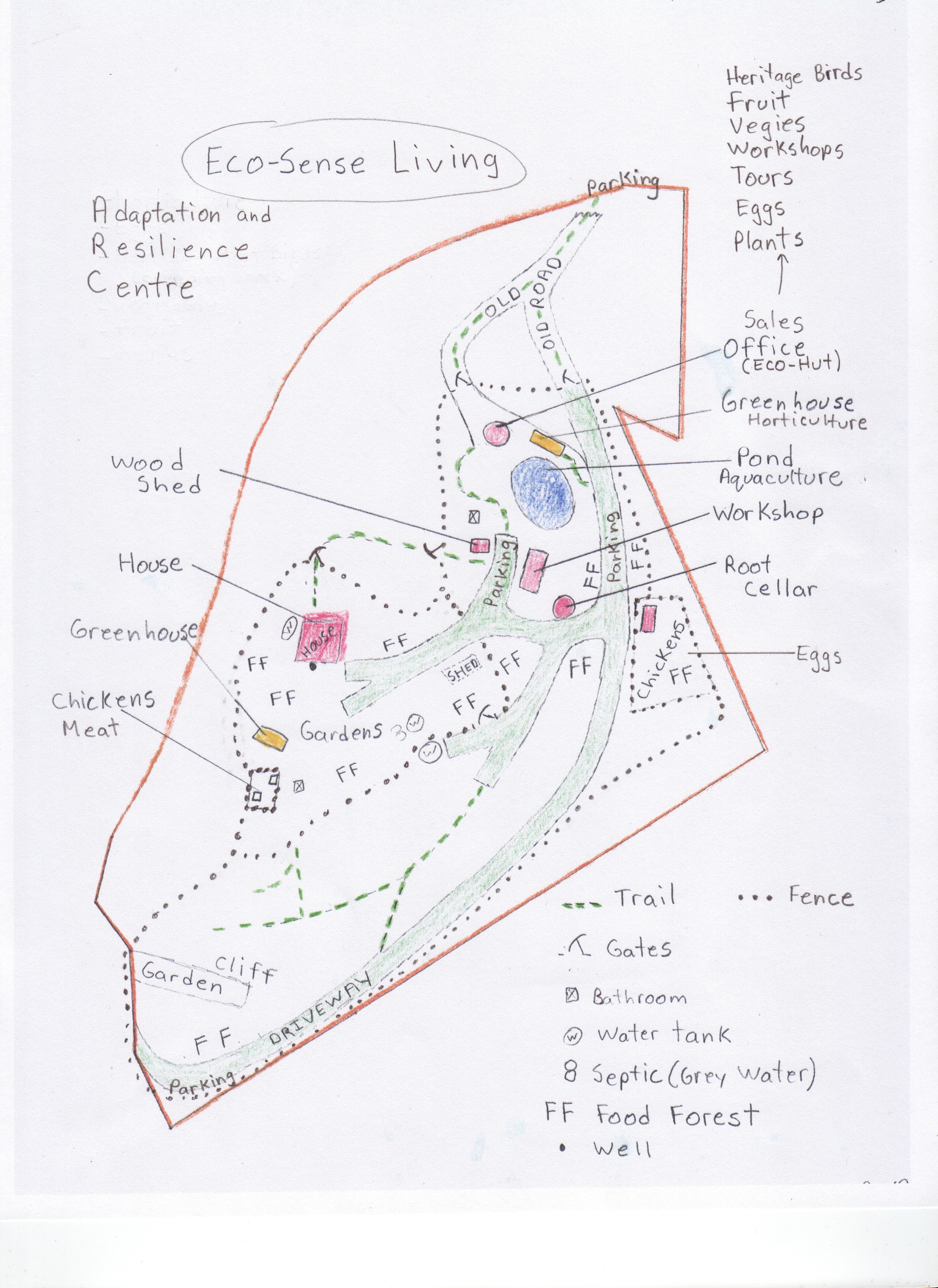
Eco-Sense Map:  Parking at bottom of both driveways or up top.

Eco-Sense Map: Parking at bottom of both driveways or up top.

This Saturday  (May 3rd) and every saturday from 10 am to 2 pm until June 28th, we’ll be at it again, and its going to be nuts.  For specific details on the open house check out our last blog post here:  OPEN FARM DETAILS:


It was a busy week here at Eco-Sense with 6 tour groups, including five grade 6 classes and ending the week with our very successful open house.  0ver 220 people personally greeted Mudpuddle and the ducklings and many purchased perennial plants and eggs.


Slug Patrol

Slug Patrol


Speaking of nuts,besides our regular mix of Actinidia arguta/kolomikta/delisiosa, Cornus kousa/mas, Elaeagnus multiflora/umbellata…   and 40 other edible perennial plants, we will have the limited selection of Paw Paws (Asimina trilba) new this week – North America’s largest fruit that is best described as a cross between a mango and banana and cold hardy to -30C.  Even more exciting is our nuts!

Crosne.  Edible small tuber with awesome fast growing ground cover

Crosne. Edible small tuber with awesome fast growing ground cover

One of the most important features lacking in the local food security landscape is the lack of nut trees in the region.  There are some around, very healthy planted many years ago, but it became more fashionable to plant inedible nuts like the horse chestnut, which line countless streets in Victoria.   We want to change that and have choice edibles that suit the yards, spaces and community gardens with our Japanese Chestnuts, Chinese Chestnuts, American X Chinese chestnuts, Yellow Horn, and of course the most exciting being the Oregon State University (OSU) Hazelnut cultivars.    Our walnut and ultra northern hardy pecan seedlings are just sprouting and won’t be available till next year.

Oca.  Lemony mini potatoes

Oca. Lemony mini potatoes

The chestnuts are the big main trees in a guild, the hazelnuts are the next layer at 12-15 ft.  For those who don’t know our excitement over the hazelnuts, we had been trying to bring in the Eastern Filbert Blight (EFB) resistant varieties from the OSU Breeding program for 6 years!   We finally have them thanks to Thom Odell of OSU,from Nature Tech, who jumped through the hoops with the tissue cultures, built his own lab and started growing the trees.   We ordered in 100 trees in the fall for this spring, we virtually sold out and have brought in more.  Good timing too, as virtually all the stock from the lab/breeder has been snapped up due to the EFB hitting the hazelnut nurseries on the island, with Courtenay growers being the latest victim having to replace all their trees, and it is working its way down island.

We have Jefferson, Yamhill, Theta, Sacajawea, Gamma and Eta, and based on your available space, we can set up a pairing of  two/three/four hazelnuts of cross pollinating trees for you.

Weekly Plant Profiles

10173567_699710030072266_2423639426299758704_nEach week we will be posting a plant profile as our way to introduce the perennial food plants that we deem viable components in a local food system.  It was hard to choose this week’s, Should it be Paw Paws, Chestnuts, Cornelian Cherry, Perennial Leek, Crosne, Oca, the Kiwis… this week it is the Hazelnuts (Corylus avellana).  To learn more about perennial permaculture plants you may be interested in this Hatchet & Seed workshop coming up on MAY 10th.


Hazelnut – Corylus avellana

Why Hazelnuts?

Hazelnuts have been a food source in this region for millennia, one of the few historical and consistent nut crops. High in fats and protein (and thus calories), stores well, and easily. That said, sadly over the past 2 years there has been a crash in the trees caused from Eastern Filbert Blight (EFB), and this EFB has finally hit Vancouver Island. This has been expected, and thus there has been a ban in BC on importing nuts that may exacerbate this, though this ban has also not allowed the growers to prep for this before now. The good news is that the Oregon State University has been researching this and creatied a breeding program to create EFB resistant varieties, that are hardier and more robust. For 6 years we have been trying to gain access but the ban has stopped us, until now… and we now carry legal OSU EFB resistant hazelnuts.

Hazelnuts are well suited for the PNW and we are one of the few places in the world where the climate is ideal, with good moisture, cold hours and pollinating conditions.

Hazelnuts require multiple cultivars for cross pollination. Some culstivars are ‘support’ trees for the ‘production’ trees, though all cultivars will bear nuts. The pollinating season is broken down into early, mid and late season, so we sell the trees in packages to match your site.

Growth

Hazelnuts can be grown as a dwarf multi-stemmed shrub to 10 feet or in tree form up to 12-15ft with the pruning of the suckers. They are wind pollinated where the ale catkins pollen is blown onto the tiny female flowers starting in January up into April.   We have found that they are great grey water plants (like our figs) so fit into grey water systems wonderfully.   When the young trees hit 4 ft tall, we snip off the top and begin to let them branch out.

Planting

Space trees about 10-15 feet apart. We plant in groups, or in line with the prevailing spring winds to take advantage of the pollen spread.

Dig a hole twice as wide and deep as the root ball (we dig our about 18” deep and wide), and roughen the sides of the hole so there are no smooth walls, as this allows root growth into parent soil. Amend the hole with half compost and half native soil with two handfuls of bone meal – fill the hole halfway. Remove the tree from the pot, ensure the root ball is wet, and separate the roots as best as possible so there are at least four of the larger radial roots heading in different directions (place the largest root the direction of the prevailing winds). At this time if you wish, add a mycorhizae innoculant to the roots – we use Mycogrow and Myke Shrub inoculants. Back fill slowly, ensuring to get the amended soil all the way around (no air pockets). Once planted, mulch in a 18” radius and water thouroughly to help set the soil and moisten up the surrounding native soil. Once the tree is 4 feet tall trim the tip to begin the branching process.

4 tree package – ($180)

Jefferson, Yamhill, Gamma/Sacajawea, Eta/Theta

3 tree package ($140)

Jefferson, Yamhill, Sacajawea
Jeferson, Theta, Yamhill

2 Tree Packages ($90)

Jefferson, Theta/Eta
Yamhill, Gamma
Yamhill, Sacajawea
Sacajawea, Gama

 The perfect 10 tree orchard ($450)

3 jefferson, 1 Eta, 1 Theta, 2 Sacajawea, 1 Gamma, 2 Yamhil


SAT April 26th 10-3pm at Eco-Sense


Spring greetings from Eco-Sense!

Tomorrow (Saturday April 26th), marks the first day of our new FARM business here at Eco-Sense.  This is not your average farm gate sales.  We are focusing on plants specifically selected for local food security, resilience, and adaptation.  More specifically, these are Permaculture Plants consisting mostly of perennials often incorporated into a Food Forest, which means that once planted they will produce food and ecosystem benefits for years to come.  If you don’t know what permaculture plants are you may be interested in an upcoming workshop on May 10 put on by our Friends at Hatchet & Seed Edible Landscaping.  Registration here:  http://www.eventbrite.ca/e/permaculture-plants-tickets-11071323627
Farm Gate Sales Open House Details:
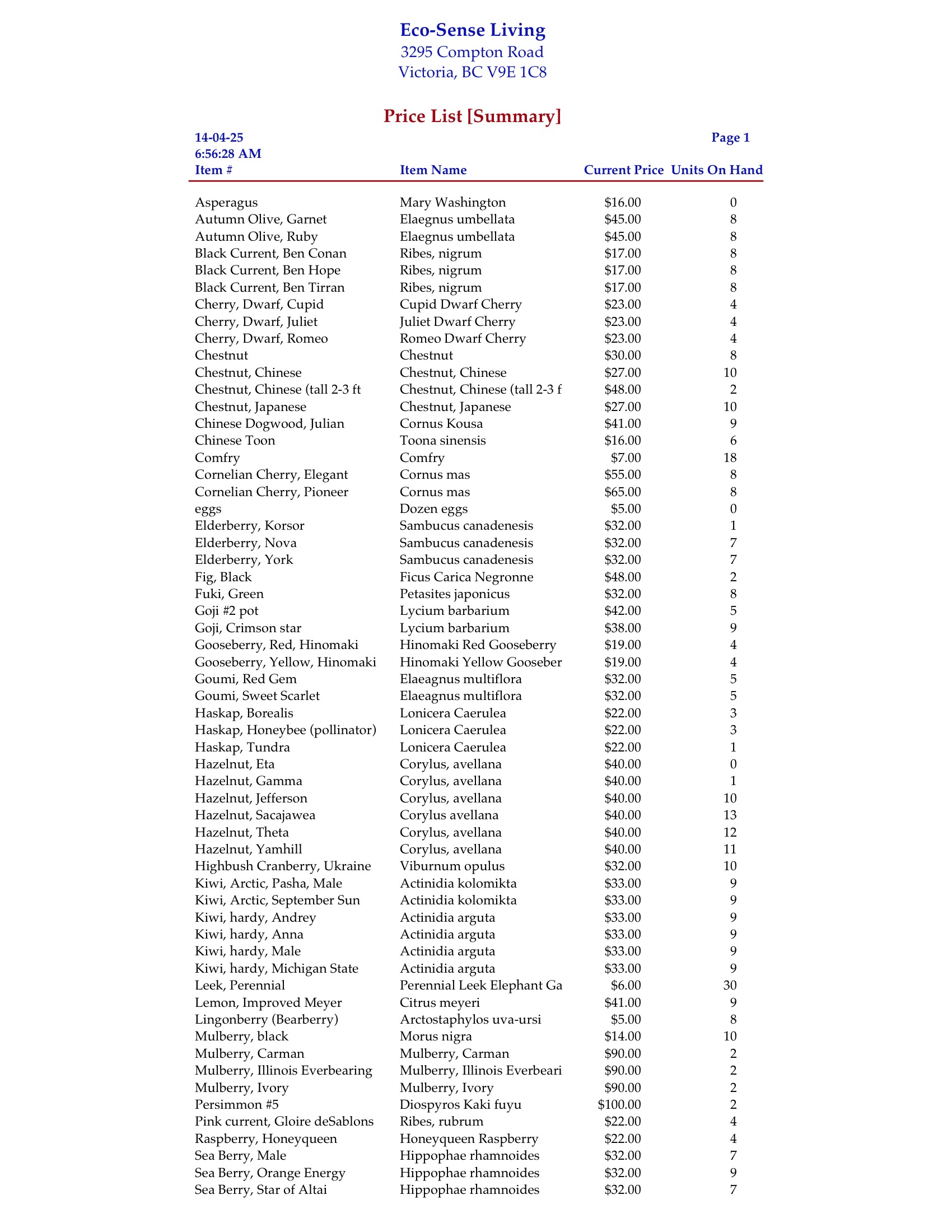
Open house dates:  Don’t worry if you can’t make it out to Eco-Sense this saturday as we will be having farm gate sales every Saturday all spring…and then every sat this fall.  Check out our website http://www.eco-sense.ca for up to date information.  We also book private appointments for people who cannot make it out on saturdays and are interested in many of our plants.   Here is a price list of just some of our plants currently for sale…it will be changing all the time:

Page 1 price list

Page 1 price list

0002BU

Page 2 price list

Paying for stuff:  We accept cash and cheques.  Sorry, no credit cards.  
What’s for sale?  As mentioned we will be selling mostly perennial plants but will also have some seeds available and other garden items throughout the season as we have extra. Anyone like kale?  Tis the season for kale and cabbage shoots.  Eggs will also be part of our farm gate sales especially this fall as our chicken and duck flocks increase.  Currently we will only have an extra 1-2 doz eggs per week as our neighbours have been buying all our eggs up.  Once you’ve eaten truly free range eggs from happy chickens, there’s no going back.  Please bring appropriate packaging materials for your purchases…box, bag, etc.
 
Pets:  We have a very affectionate and annoying dog named Boo.  Please don’t let him jump up on you…he responds to body language, so just turn your back on him…this works with Gord too.  We also have a very friendly DUCK named Mudpuddle…she LOVES people, so please don’t step on Mudpuds.  Please leave your pets at home as our dog, chickens, chicks, duck, and ducklings would be upset by a temporary addition to the zoo.  Even if your pets are well behaved, ours are not.

Mudpuds leading a tour

Mudpud leading a tour

Parking will be interesting:  If you think you might be just coming to check it out or buy only a couple little items, you may wish to park at the bottom of the hill and walk up…our driveway could be a bottle neck and parking is limited up top.  Check out the attached Eco-Sense map for parking options.  Gord and I are going to have a go at the driveway with pick-axes and shovels this afternoon to create a wide spot for cars to pass.  Wish us luck!
Map of Eco-Sense:  
Eco-Sense Map:  Parking at bottom of both driveways or up top.

Eco-Sense Map: Parking at bottom of both driveways or up top.

Pathways:  You are welcome to wander around and look at gardens and the food forest while you are here, but please stay on the pathways and watch where you step.  We have PLANTS everywhere that are young and just getting started.  The wild flowers are also out in FULL BLOOM and BEAUTIFUL.
It’s been a busy week around here as we’ve had 6 tours, tonnes of emails, and are getting ready for the open house.

Tour group in front of Eco-Hut (office for farm business)

Tour group in front of Eco-Hut (office for farm business)

Thanks for sharing in our new Eco-Sense journey.
Hugs to everyone,
Ann and Gord

Filling our vessels


Water

Who would have thought that anyone in Victoria would be wishing for the rain in February?  Well, we are, and are happy to announce it’s arrived 4 months late, and it’s filling our vessels!   Not Ann’s or Gord’s bladder type vessels, but our pond, infiltration pits, swales and soils.  Unfortunately, with the rain finally arriving, our well water is now contaminated yet again which has become a yearly event following the seasonal rains…this year, it was just a few months later.  Water has become very symbolic this past year (2013); it’s been a year that’s caused a lot of reflection after witnessing Californian’s lose their ability to see their reflections in their lakes and reservoirs due to a continuation of their 3rd year of drought, and the rest of the continent reflects on what is in store for their food supply as a result.  We have become aware of how quickly things can change due to government policies allowing fracking and toxic dump sites to occur atop of watersheds and watching industrial accidents spill copious poisons into the life blood waterways.   If this doesn’t define stupid, I don’t know what does.  Consequently it has been a winter of thinking of water, where it flows, how it filters, where it stores and how blatantly it’s destroyed with absence of thought.   How are we preparing here at Eco-Sense and what are we learning… hold on… we are about to tell.Rainwater Collection

Coming out of our MUD Cave

Like treading water, Ann and I had taken a hiatus for a year to reflected on a lot learned over the past 7 years  – with the past two, feeling like we were stuck in the mud.  This basically provided a year off from speaking engagements, tours, and teaching, and instead allowed us to turn our energies and efforts towards the land.  I’m sure we hear laughing from those who know us (as solar energizer – free range organic bunnies) and wonder what taking time off looks like.    We have had some bumpy potholes, as family’s do, feeling like we were drowning in the small details, and losing site sometimes of the bigger picture. This was compounded over the past 2 1/2 years, with the maturing realization that rather than focusing on avoiding (mitigating) abrupt climate change, we have already passed the climatic tipping points.  Mitigation no longer seems like an option, adaptation must now be our focus, with connected local economies focusing of basic needs like food and water.  Food systems for a changing unpredictable climate with tougher plants and eco-systems should’ve been planted 5 years ago.  We’ve all got lots of work to do.

350 ppm atmospheric concentration of CO2 is long gone...

350 ppm atmospheric concentration of CO2 is long gone…

This awareness redefines our priorities and has spawned urgency to get our compost together with our resilient and redundant food and water systems.  This past year we started on the creation of perennial food systems, and now we are again ready to begin teaching classes, sharing our successes and failures, and selling plants that we have incorporated for our drastically changing climate.   We are coming back out of our cave.

Tour group learning about grey water

Tour group learning about grey water

The Compost is Hitting the Fan

The global climate is changing rapidly… powered by the decrease in temperature differential between sub-tropical air and the arctic air powering an unprecedented shift in the jet stream.   http://www.youtube.com/watch?v=_nzwJg4Ebzo  From historic floods in the UK, to the droughts in California, to the heat waves in Australia and the arctic, the melting permafrost, the methane release, and the freezing temperatures throughout central north America, one can easily see that civilization and ecosystems are in decline…rapid decline.  We can’t change this, and instead of being crippled by despair and the inaction of our global society, we can just get on with living and helping people to help themselves.  This is a time of immense opportunity and change.  Time to adapt as best we can and put some roots in the soil.

Putting roots in the soil with some friends

Putting roots in the soil with some friends

Identifying Opportunities and Facing vulnerabilities 

Pond(ering) this reality, and understanding what the implications are for us, we expect to have longer drier summers and this winter in particular a lack of rain.  We cannot think of any one strategy in isolation.  Our food relies on water, water is impacted by the changing climate (politically and environmentally), energy  is required to move water, and then we must store it and look after it.  Aside from the standard rainwater cisterns, earthworks are used in a variety of ways to help control water resources – we are always amazed at the earthworks demonstrated on some of the mo(i)st amazing projects around the world… but unlike many of those projects, our opportunities are different as we live on a hill of fractured bedrock, with limited soils, and summers of drought lasting three or more months.  One thing for sure, we know that our home, on top of the hill, will never flood.

DSC01040

Water: slow it down, spread it out, soak it in. New blueberry and tea patch. This area accepts the water run off from the upper driveway.

Taking out a blackberry patch - installing swales and hugelkultur beds preparing for perennial plantings

Taking out a blackberry patch – installing swales and hugelkultur beds preparing for perennial plantings

But when the rains do come, we have to plan for water abundance (extreme rain events).  We need to drastically slow it down, spread it out and sink it in, or we’ll lose this resource as runoff taking our soils with it like a thief.  We need to keep it in the soil, soak it in, and recharge our ground water.

Gord’s irrigation system moistens Ann’s gardens.  Perennials

Married

Married

Don’t jump to conclusions… we’re married.  What we are trying to elude to is finally the installation of an irrigation system and perennial food system.  We are transitioning our food systems to more perennial plants for six main reasons:

  • They require less/no irrigation once established
  • They hold the soils together in extreme rain events
  • They don’t need to be replanted every year in changing weather patterns
  • They produce abundant more reliable food crops with LESS work…eventually
  • They build more soil and do not require outside fertilizer inputs when appropriate design is used.
  • They are not subject to failure due to late or cold springs (like annuals)

So on the water theme, we installed an irrigation system hooked up to the rain water catchment from the house, with a redundant top up support from the deep well.  This freed up our time to get a little more dirty, so much time in fact that we created a food forest (or three).DSC00696

A food forest is a human designed forest of ecosystem enhancing plants that follows the basic design principals of forest ecology to provide for our human needs and that of many other species.

The first phase is planted amongst a grove of Arbutus (which had been previously gardened).  We’ve planted tea, seabuck thorn, josta, black currant, gooseberry, hardy kiwi, fuzzy kiwi, European olive, autumn olive, Arbutus unedo, grapes, chestnut, mulberry, Capulin cherry, amaranth, Sezchaun pepper, goji, blueberries and more.  What does this mean?   More water please.

PONDering the dilemma

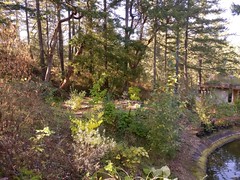
Hidden away at the top of our driveway there is a man made pond that was here before we moved in, long since overgrown with willow and cedar, and due to its unkept status was as useful as a leaky gumboot.   As any woman could attest to, the pond was a failure in it ability to hold its liquor of life for the very reason that it was man-made.  So to remedy this, Gord de-forested it over two months, and then looked to Ann’s womanly skill at retaining water.   The size is about 100,000 gallons (400,000 liters).    The pond process did require the use of a machine for 2 days, which dug and sorted the existing soils and clay, and re-laid them with the worst layers on the bottom, progressively better layers atop, capped by a top layer of blue clay.  Over the summer we sprinkled 30 sacks of bentonite clay into the cracks and then waited, and waited, and waited and…. while waiting we used all the chipped materials from the clearing to mulch all the bare landscape surrounding the pond and planted copious nitrogen fixing plants to enhance the soils for this year’s plantings.

resurfacing the old pond

resurfacing the old pond

In deciding to go this route with the pond sealing we researched out a variety of systems, inclusive of gley (building an anaerobic bio-film layer using straw and manure layers capped under clay soil), EPDM liner, Polyurea spray liner, concrete, animals (pigs) to puddle the existing soils, geese/ducks… the list is endless.  Finances, materials, time frames, and ecological concerns, lead us to choose the clay for re-sealing the pond.  Fingers crossed!

DSC01116A pond in and of itself has great ecological diversity, but the fun part, is to imagine and expand how many uses it has, and integrate resilience and redundancy into integrated systems.  So… we connected the house rainwater cisterns to feed into the pond as needed; we can pull from the pond to water the upper gardens and house as required;  we have enhanced fire suppression both as a source to draw from and to maintain a more moist less flammable vegetative barrier;  we installed a suction feed out of the pond to the lower gardens and future site of a small dwelling.

The pond also provides:

  • Micro climate for the other food forest areas being installed  this spring (another 1/2 acre),
  • A home to a host of plants that are edible for us (Sagittaria latifolia) ,
  • Food for us/chickens/ducks (Azolla, duckweed and eventually fish),
  • Supply of green manure for summer mulch and compost fodder,
  • Future home to a modified aquaculture systems, tied to the new greenhouse (salvaged solarium), heated via thermophilic compost next winter,
  • Continued support to the ground water recharge as the earthwork slowly seals over the next two years,
  • Protection from storm surges washing out roads and other infrastructure,
  • A beautiful reflection of the fullmoon  into the new (all used materials) Eco-Hut perched beside it, acting as the new office for our farm/nursery/resiliency/get-your-shit-together-connect-the-dots business.
Eco-Hut (under construction)

Eco-Hut (under construction)

Slippery slope

So the slippery slopes of the clay pond lends itself to providing a fine excuse for taking a year away from our sustainability advocacy role.   What it also means is a host of projects including a new building (the Eco-Hut or as Ann calls it, the “Woman Cave”), solar PV systems installed, cob being made, plants being researched, ground covers planted (and already harvested).  Even Ann with her stoic rationale manner has slipped into the murky waters and has been busily searching for perennial vegetables to fill the gaps, been creative once again with trowel in hand, and flapping her arms and saying  “Quack, quack. ”

Gone Quackers?

Quack, QUACK?  Yup, Ann has (quacky) khaki Campbell ducks on order, for adding to the grass eating, wing flapping, egg laying antics around this crazy place.  Duck coop built and installed, symbolically in the rain… the wonderful rain that has made us mucky, wet, cold, and happy.

New Duck Coop near the pond

New Duck Coop near the pond

Come April we’ll be busy with:

200 more plants to plant (see list of what we are growing at the end of update)

Food Forest Plants

Food Forest Plants

Getting ready for the first farm gate sales open house on April 26th.  See https://ecosenseliving.wordpress.com/edible-plants-for-2013/

Our first course this year with a 2-day immersion of “Permaculture Systems In Action”.  We have partnered up with Tayler and Solara from Hatchet & Seed.  http://www.eventbrite.ca/e/permaculture-systems-in-action-tickets-8912073251

From feeling drained to feeling, well, pumped, with vessels filling every day, we are ready for the storm and expecting to be swamped.   So for those in despair, don’t cry us a river, grab a paddle and build something that floats (a life boat perhaps) and paddle against the currant to a place that has less life stuff and more lifestyle.Ann and Gord

Cheers,

Gord and Ann

Links we found interesting or useful recently (just a few of what we have read or viewed):

http://arctic-news.blogspot.ca/2014/02/massive-methane-concentrations-over-the-laptev-sea.html

http://www.npr.org/blogs/krulwich/2014/02/18/279189378/trees-on-the-move-as-temperature-zones-shift-3-8-feet-a-day?utm_content=socialflow&utm_campaign=nprfacebook&utm_source=npr&utm_medium=facebook

Local Communities Dismantling Corporate Rule, part 1: http://www.youtube.com/watch?v=8Prylnj4NQ8

http://www.straight.com/news/588366/gwynne-dyer-its-abrupt-climate-change-stupid

A localvores Potluck: http://www.youtube.com/watch?v=NO_MBaWDOmw

Clive Hamilton,”Requiem for a Species”: http://www.youtube.com/watch?v=2mccKiZ9AfE

A must read with lots of very useful links: http://www.resilience.org/stories/2014-02-10/come-on-home-ecological-agriculture-and-sixteen-wonderful-farms-that-point-the-way

Salmon documentary:  http://www.youtube.com/watch?v=MTbxOFcvC4U

Crash on Demand, by David Holmgren.  http://holmgren.com.au/crash-demand-discussion/

http://mahb.stanford.edu/blog/collapse-whats-happening-to-our-chances/

http://www.nationaljournal.com/video/the-one-video-to-shut-down-all-of-the-climate-change-deniers-20140130

Plants at Eco-Sense

Shiny Leaf Yellowhorn, Heartnut, Butternut, Siberian stone pine, Pinyon Pine, Swiss Pine, Italian/American sweet/Chinese chestnuts, Gingko, Catalpa, Honey Locust, Black locust, Siberian pea shrub, European olive, sezchuan pepper tree, fuzzy kiwis (Hayward and S. 12), comfrey, borage, lambs quarters, bay laurel, EFB Resistant hazelnuts (Jefferson, Yamhill, Gamma, Theta, Eta), Chinese Date Plum, Japanese persimmon, American Persimmon, Hardy pecan, Apricot, Japanese plums, Italian plums, Wild plums, tayberry, josta berry, goji (lycium and babarum), goumi, tea (2 types), autumn olive (6 types),  seabuck thorn (6 types), hardy kiwi (2 types), Arctic Kiwi, fig, red/pink/white currants, black currants (Ben series), lingon berry, wintergreen berry, oregon grape, salal berry, trailing wild black berry, Himalayan/thornless black berry, logan berry, black/red/yellow raspberries, yellow/red gooseberries, saskatoon berries, echinacea, Chinese ginseng, siberian ginseng, arbutus unedo, capulin cherry, dwarf sour cherry (Romeo, Juliet, Cupid), Russian Almond, Paw Paw, apple (10 cultivars including our very own unique Boo Surprise), Elder Berry (4 edible cultivars), Russian olive, English (Carpathian) walnut, Black Walnut,  Mulberry, hostas, grapes (6 varieties), pears, daikon, Jerusalem artichoke, sunflower, sweet potatoes, yacon, oca, Japanese yam, schisandra, camas, chocolate lily, squash (various), Melons (various), yerba buena, yarrow, stinging nettle, parsley, ginger, sage, rosemary, oregano, garlic, potatoes, kohlrhabi, carrots, parsnips, beets, broccoli, kale, cabbage, brussel sprouts, kale, tomatoes, tomatillos, cucumbers, peas (various), beans (various), pomegranate, fuki, Meyer lemon, Cornelian Cherry, Chinese dogwood, azolla, Sagittaria latifolia, mints, basil, butteryfly bush, Fava, dock, mustard, lettuces, Chinese greens, mustards, willow, walking onions, ground cherry, hops, mushrooms (garden giant, oyster, puffball, shaggy main, prince agaricus, black morel), miners lettuce, cranberry, quinoa, chick peas, blue berries, rosa rugosa, poppy… with the hopeful additions of ramps, perennial leek, welsh onion, good king henry, sweet cicely, giant soloman seal, asparagus… just to name a few.