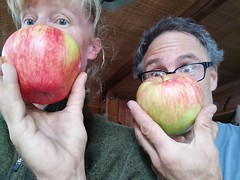
YES, we are open this Sunday (Oct 30th) from 10am- 2pm for sales of Perennial Edible plants. 3295 Compton road in the East Highlands.
Here’s our up to date plant list with most of our most popular plants IN STOCK.
Here’s some photos from yesterday.
YES, we are open this Sunday (Oct 30th) from 10am- 2pm for sales of Perennial Edible plants. 3295 Compton road in the East Highlands.
Here’s our up to date plant list with most of our most popular plants IN STOCK.
Here’s some photos from yesterday.
Posted in Eco-Sense Updates
Last Sunday we closed our nursery in anticipation of the big storm…which never happened. It was however a good practice run to think about how we would prepare for, and try to mitigate for, extreme rain and wind. Very grateful that nothing much materialized.
We are all ready for this weeks open house for sales of perennial edible plants.
WHEN: Sunday Oct 23 from 10am-2pm
Sunday Oct 30 from 10am-2pm
WHERE: 3295 Compton road in the East Highlands
We are well stocked with all the hard to find food forestry edible perennial plants. The whole idea of creating edible forest gardens or food forests is REALLY catching on. People are doing it small scale in their yards, farms are creating larger landscapes of food forests, and municipalities are landscaping with edible perennials for beauty and function.
Check out this recent project with the City of Colwood that Eco-Sense has had the privilege of participating in. http://www.colwood.ca/news-events/news/2016-10-06-000000/painter-trail-official-opening-celebrating-new-connections
Here’s the up to date list of plants available at Eco-Sense: Plant List

Council initiative of the week:
The entire council of Highlands is not supporting the CRD Regional Growth Strategy (RGS) update as it currently stands. All municipalities in the region need to give it support in order for the document to come into legal effect. The whole idea is for the region to collectively decide how and where to grow. The fact is that people are moving to this region, and we need to plan responsibly for this.
The one final sticking point in the RGS is about using water servicing as a growth management tool. Historically the RGS did have this tool, and the revised RGS is proposing to remove this tool to limit growth. Initially there were many municipalities that were opposed to removing water servicing as a growth management tool as it would make it more difficult to control sprawl into forested areas a long ways out of town. But now, only Highlands is saying no. So Highlands may have to go this alone meaning forced mediation…and if that doesn’t work, then forced arbitration. For all of this, Highlands would have to pay half of the legal cost. This potential legal cost… this is a really BIG deal for such a tiny community to feel so strongly that we would hold up the entire region by not supporting the RGS. The specifics as to the impacts seems to be lost on all the other municipalities sadly.
Gord and Ann have coined a new term for the RGS: the Rapid Growth Strategy.
Mary Lake Park: A group in the Highlands is working their butts off to try and buy a piece of land to turn into a park here in the Highlands. This project is led by Bob McMinn, who at 92 seems unstoppable. He has assembled a team of dedicated volunteers working to make this a reality. This park land is simply amazing and would complete a 25km trail loop through the Highlands. Check out their website and follow their progress.
See some of you on Sunday,
Ann and Gord
Posted in Eco-Sense Updates
A notice to all that we will be closed Sunday October 16th
Why? Potentially the biggest storm to hit this part of the world, at least since 1962, with potentially 150kmh winds and lots of rain…enough rain to fill the pond for the first time EVER. We will be open the following Sunday Oct 23rd from 10am-2pm. People can also make private appointments to buy plants. email gord@eco-sense.ca

For DISTRICT OF HIGHLANDS Residents PLEASE SEE BELOW
This is a quick note with some useful links to get info & share info for the storms for the next couple days.
PLEASE share with other Highlanders.
Ryan Hobbs the Highlands Emergency Co-ordinator has a twitter feed noted below, and has updated information on the Highlands District Website (also below).
Ann and Gord’s Twitter Feed Ann & Gord @BairdEcoSense https://mobile.twitter.com/BairdEcoSense
Highlands Emergency Preparedness Twitter feed https://mobile.twitter.com/HighlandsEP
Highlands Fire Department Twitter feed https://mobile.twitter.com/HighlandsFire
Highlands Fire Rescue Facebook Page https://www.facebook.com/HighlandsFireDept/?fref=ts
Highlands Sustainability Group Facebook page https://www.facebook.com/groups/308466883984/
Things to think about:
More detailed information found here at the DOH Emergency Response section ( http://highlands.bc.ca/183/Emergency-Preparedness )
Wish you all well
Ann and Gord
Posted in Eco-Sense Updates
Yup, you read the title correctly… and that’s NOT just Ann ranting about positive feedback loops. It has been a whirlwind of positive ripples over the past few months.
The one negative impact of all the positives is we only have 3 Open House Plant Sale days at Eco-Sense scheduled this fall…

Hardy Kiwi – Ann’s new favourite fruit
Farm Gate Sales of Perennial Edible Plants: Same deal as last year. If you are planning to buy plants, please drive up to the top and find a parking spot. If you are not buying plants you are still most welcome to come and walk around our permaculture homestead but we ask that you park at the lower gate and walk up. We also ask that you do not bring dogs as we have free ranging ducks. Formal tours do not occur during our open house days as we stay close to the nursery, however we do enjoy conversations on anything from composting toilets to political rants and everything in-between as time permits. Our annual gardens are still producing incredible abundance in their very chaotic fashion…we’ve been a wee bit busy lately, so hopefully we don’t lose anyone in the overgrown gardens.

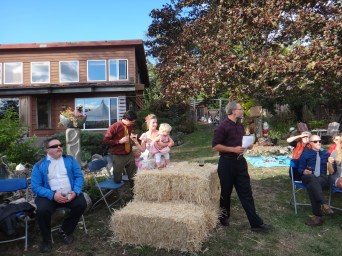
Attending our friends Tayler and Solara’s amazing zero waste, local food potluck wedding set in spectacular gardens with their amazing friends and family.
Where to start… hmm maybe with point form:

Squash and Grapes in a food forest – Summer abundance

Guess what this is?

Sweet potatoes growing on the roof between the Solar PV and Solar Thermal.


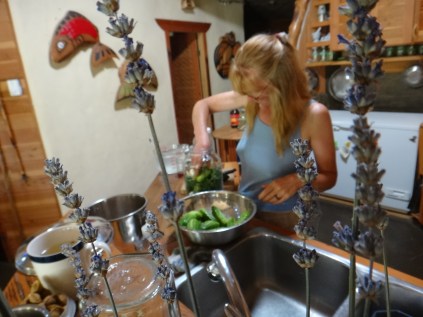
Gord helping out in the kitchen, complete with drill for making kebobs – in his stylish manpron (man apron). And yes that is a mink pelt hand towel hanging at his waist.
Ok, that’s it for this week. Hope to see some of you on Sunday from 10am-2pm.
Gord and Ann
Posted in Eco-Sense Updates
STAYING HOME. We have decided to go on holiday, and like the majority of people in our culture, we decided to have a carbon footprint to add to our holiday joy. We thought about a plane trip somewhere wonderful… but there was no place to go that was as beautiful as our own home. We thought of a tent camping trip through the Rockies, but the last time we did that we saw slopes of climate ravaged dead pine and way too many luxury RVs. So we figured out a way to play the carbon footprint game right here at home. A way we could do our part to feel like one of the gang.

View to zone 1 from front door.
Bring on the CONCRETE (and sarcasm). We decided to make raised garden beds at the front of the house, and we chose to use the highest carbon footprint construction material we could get our hands on. Woohoo! After all, if you are going to pump greenhouse gases into the air, you might as well do it right the first time. So we thought we would skip the cedar and move right into the concrete. The carbon emitted from the concrete industry is like putting the atmosphere on crack(ed) and fracked greenhouse gas.
Cedar as option 1. Our first option was wooden beds. Not fancy, but O’NATURAL. It seems more eco… (and usually is). Based on our experience, we would have to replace the beds every 6 years or so, and there was concern over disturbing the perennials we had planned on planting – olive, persimmon, tumeric, lemon, and ginger. We also thought about getting older and having to rebuild it too many times over our short lives. We thought cedar would be a lower carbon footprint… but dammit, we wanted permanence and concrete.

Ann contemplating the carbon footprint.
This is what we found when Gord put his nerdy hat on. Basing our calculations on 240 board feet of red cedar, that pre-milled comes in at a weight (based on 12% moisture) of approx 453 kg, with a carbon footprint of 0.119 kg/kg, means the beds would account for 54.74 kg of ghg equivalents (GHGe). This does not include nails, metal brackets, or anchors that would be required to assemble and anchor it to the ground – add in 5 kg of metal at a multiplier of 4.0 kg and you can add another 20 kg of GHGe for a one time total of 74.74 kg GHGe. Now, based on replacing them every 6 years (from experience with our other beds), we would expect to go through 6 replacement cycles over our life span (Gord being 83). This equates to 448 kg of GHGe attached with the front beds over time. This does not account for the time and effort it takes to remove the plants that have been established, rebuild the beds, and replant – consuming probably 4 – 5 days of labour each time. (and the extra beer consumed). There is one additional caveat to this calculation as most embodied GHGe equations addressing wood carbon footprint do not include the carbon sequestered in the wood – for every m3 of cedar there is 632 kg of carbon stored… that is released upon decay. In our above scenario we are dealing with 0.566 m3 (357 kg of carbon) which could be assumed to release 20% of its store every 6 years (357 X 20% X 6 = 428 kg of carbon over its life span). The real number of the GHGe over its lifespan could be closer to 876 kg. CEDAR OPTION = 0.876 tonnes of GHG’s

Homemade lime “el fresco” paint made with earth pigments
Concrete. Ann and I are not fond of concrete strictly due to its impact on the environment. With our evil Dr. Evil hats on our head, it would seem logical that concrete may be the easiest for us yet the worst environmental solution.
We used 341 kg of portland cement at a carbon footprint of 272 kg of GHGe. Add 40 kg of metal lath and steel rod (combined) with a GHGe of 160kg, and the sand 2267 kg which has a GHGe of approx 5 kg, and the total GHGe would be 436 kg. CONCRETE OPTION = 0.436 tonnes of GHG’s

Beauty and function to last a LONG time…just like the cob house.
And the WINNER IS CONCRETE. So over a period of 36 years, between the two options, the option with a lower initial carbon footprint and the one with the larger, get flipped on their head. Where they differ is that the beds of concrete will continue to produce food past our life time, and hence will have been a better carbon investment. The concrete also adds to the thermal mass to create a micro climate on the south wall of the cob house – thus we can grow turmeric, ginger, olives, lemons, and MORE WINTER VEGGIES.

Gord contemplating his carbon footprint.
We are not justifying the use of concrete in no way, as concrete used to an excess without care, and without a long term vision is a frivilous waste of carbon. This is so clearly prevalent when we look to its use in the various bridges and buildings built with life spans of 30-40 years (BC Place Stadium; bridges crumbling in Quebec), monster homes, and much of the indulgent infrastructure in our civilzation. Excess use is not the point I am driving home, but instead conscientious use… appropriate technology for the job.
OUR CARBON FOOTPRINT. We have had many discussions over the years of what it would take for us to further reduce our personal carbon footprint (which is between 3-4 tonnes each. Canadian average is about 20 tonnes). We would have to give up technology (like computers, pumps, solar panels, etc); household appliances (like washing machine, propane stove, etc); workshop tools like table saw, drills, mitre saws, planer, sander, grinder, etc), and of course our farm truck and diesel smart car and COFFEE. OMG…not the coffee. All of this would mean we would no longer be able to be a farm selling perennial edible permaculture plants, we could not be on muncipal council without a car or computer and especially the coffee, and we could not even clean the public composting toilet (as we bring the humanure here in the truck to compost). So in summary, we are just as trapped in this civilization as as everyone else (which is why the SYSTEM needs to change). So, we continue on growing most of our food, helping others grow food, give our tours, teach, consult about better ecological design, and bring many new conversations to the council table as we help to set local and greener policies to impact as much as we possibly can.
So maybe we failed; maybe we impacted the climate; maybe we created awareness? We don’t know. Maybe next time we’ll choose the option thatpromotes the clear cut of old growth cedar to achieve our mischievous deeds. Or maybe grow some black locust which lasts much longer than cedar and grows faster AND it feeds the soil with nitrogen…but alas, black locust is invasive. Always pros and cons.
Resources Gord used to make these calculations:
https://fpinnovations.ca/ResearchProgram/environment-sustainability/epd-program/Documents/western-red-cedar-lumber.pdf
http://www.co2list.org/files/carbon.htm
http://www.vtt.fi/inf/pdf/technology/2013/T115.pdf
http://www.sustainableaggregates.com/sourcesofaggregates/landbased/carbon/carbon_energy_use.htm
http://www.translatorscafe.com/cafe/EN/units-converter/volume-lumber/4-1/
http://www.naturallywood.com/sites/default/files/UK-Carbon-Footprint-Factsheet.pdf
PS: We did consider stone, and did not include this in the update. The use of it would actually involve about similar concrete usage in the creation of the foundation and the mortar. YOUTUBE videos of the process Part 1 and Part 2.

We co-created an abundant, biologically diverse, and beautiful home that is a “being in place”.
Posted in Eco-Sense Updates