We have never taken a course in permaculture, in electronics or electricity, engineering, construction, cabinetry, waste water, horticulture, cheese making, etc… the list goes on. One of the main beefs we have with the whole concept of “permaculture” is the assumption that the teaching and learning leads one to a place of competence. It doesn’t. In reality the principles learned are just the start and gives folks coming out the other end the basic tools, ideas, and incentives to change their life and the world. There is no doubt that completing a permaculture design class is a great first step and it can be life changing for many, but it is only the beginning of the learning…life long learning.
I (we) don’t classify ourselves as “permaculturalists”, nor specialists or experts. We hold the view that any action we take has to increase the value of the 5 capitals (natural, social, human, manufactured, and financial). We also apply the rationale that we as human animals are not that different than our ancestors 100,000 years ago, nor are we any more or less special than any other organism. We also don’t see permaculture as a “new” way of living in the world, but as the way of living that all organisms “must exist” whether by integrated conscious design or unconsciously as designed through evolution.
First Nations: We recently attended a local function where Dr. Nancy Turner spoke of the First Nations in and around BC. Her specialty is Ethnoecology, which is the study of multiple integrated disciplines and how they interconnect to support a community and culture. This includes archaeology, botany, physics, anthropology, economics, psychology… you get the picture. This was a beautiful presentation in that stories were used to explain the interconnected systems the First Nations employed to survive and flourish sustainably.
 These systems were explained through stories such as of the clam beds, made and tended over generations, how the beds were tilled to enhance aeration, re-seeding was done, and engineering to retain and enhance beds. First nations improved personal food yields and the ecological integrity of diverse ecosystems. The same was done with camas, rice root, soap berry, etc. Select plants were interplanted with others to enhance production, like the soapberry, which is a nitrogen fixing Elaeagnus species related to goumi and autumn olive. Fish guts and clam shells were transported over great distance to feed prime berry bushes. The understanding that certain seaweeds were to be harvested when nettles were a certain height was only known because observations that these two grew at the same rate. All this knowledge was passed down for generations through story telling. Cultural evolution. Ultimately what was so apparent, was that the First Nations had been practicing what we call now “permaculture” because it was the only way to sustainably exist in the natural world. (As opposed to our unnatural dying unsustainable human created fossil fuel word). Through the entire talk, the word “Permaculture” was never mentioned, but it was clear to us that first nations were practicing permaculture as we now define it.
Our past four blog posts were a demonstration, through story, of just some of the twelve “permaculture” principles :
It struck us after Dr. Turner’s presentation, that survival of current and future generations depended on close observation, causing marginal mid level disturbance, self regulating harvest, learning from one’s actions, and always responding to change. When First Nations harvested huckleberry, they observed how bears always left some on the ground, so they did too. When streams dried up and showed distress or had to be repopulated with salmon, they knew how to transplant salmon eggs from another place.
It strikes me time and again that because we do not have to live directly connected to the natural ecosystem, that no amount of “permaculture” teaching and training is going actually teach one how to be one with the natural world…to re-integrate into our place in nature. The only way to learn these skills (and ways of being), is to be fully immersed with the land and with a culture of similar people. We are just starting to learn this ourselves. Sadly, the information is easily lost within a single generation, and for the First Nations, residential schools is where that disconnection was created…what an enormous loss. With Western Culture, that disconnect has been multiplied over generations spurred by technological advances for 100’s of year. What a global mess we now have.
The style of learning within First Nations was critical in actually teaching this most important skill. To learn, you had to watch and observe and not ask questions until you had fully thought about something. Only after observing could you ask questions. This style in and of itself taught people how to closely observe and pay attention to the subtleties of their environment, and to be in the moment… a tool/skill that we see as rare in our busy culture.
This brings us to the next “Permaculture” principle. Integrate not separate.

Solar real estate on the Eco-Sense roof: Growing food, producing electricity, making hot water, and harvesting rain water. Nice View too!
What stories can we pull from our experience with modern day permaculture that can demonstrate this? The first may be the story of the living roof which integrates multiple functions other than just beauty or habitat replacement, but also pre-filtration for rain water harvesting, reducing the heat island effect, sound insulating, slowing storm water flows thus reducing infrastructure to address storm flows, cooler temperatures resulting in increased efficiency of our solar panels, food growing opportunity away from voles and rabbits, and aided fire resistance. Did we know all these integrated benefits before we started, NO, but we have observed them over the years.

Angela drawing beautiful creatures on our cob home during one of her visits

A cougar

a Great Blue Heron

A Dragonfly – at the oldest insect

A Tree Frog – a sensitive amphibian
Another story would be that of Angela Evans, who we spoke of in our last blog. Angela was a planner with the municipality of Saanich. She introduced us to the concept of toxic building materials, and the Living Building Challenge program. Angela spent some time here at Eco-Sense leading the very first tours on our home while it was under construction and also conducting workshops on composting toilets here. Sadly , Angela passed away a few years back… cancer. We are so grateful for all that Angela shared with us especially her knowledge of toxic materials and chemicals. On one of Angela’s visits 10 years ago, she also created beautiful images on our cob home.
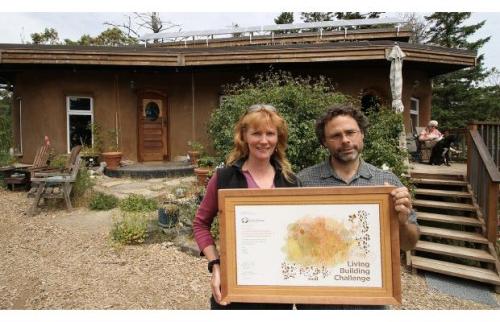
Displaying our Living Building Challenge Award
That same blog post (A Blast from the Past ) lead to introductions with John Horgan (an NDP MLA), who is now the leader of the provincial NDP. John read about our event called the “Celebrity Flush” 10 years ago and simply had to come and meet us. After that, John went on to speak about us in the Legislature, and to advocate for us with regards to BC Hydro, and he even organized a couple tours here with other MLA’s (from other parties). John’s a good guy and we really like him, but we do have very different political leanings. Our values are much more Green leaning, but we sure do hope that John will be the next premier of BC…with a minority government and with the Greens holding the balance of power.

John Horgan (MLA and leader of the BC NDP), Gord, Ann, Liberal Minister Naomi Yamamoto (Building Code Renewal and Reform)
For us, the Green party represents policy based on science and facts and not on ideologies. However this is not so popular these days in global and local politics as science and facts are in a direct conflict with our cultural ideology. Especially around the climate and the economy while sticking band-aids on all the social suffering and inequality rather than getting to the core of the underlying problem. Drastic changes are happening with regards to human civilization and ultimately facts matter regardless of what we want or what political party we align with.
Here’s a couple of links: FACTS on CO2: FACTS on Achieving Paris Agreement Targets to maintain a livable planet. These are not political links; these are links to facts.
Permaculture is NOT new: So it may sound like we are separating ourselves from “Permies” and thus not integrating them. The take away point is that folks who learn permaculture need to not treat it like the holy grail, not treat it as an epiphany, but rather be humble that it is about moving back to ecological and social principals that first Nations have been practising for countless generations. And with moving back to critical thinking and an integrated way of being, we think it is imperative to slow down, learn to deeply observe, then learn from what nature is teaching us, and realize that if we are lucky, perhaps the next generation or two will learn the tools grounded in natures reality to have a new culture and knowledge base that begins to emulate the amazing skills and values of the First Nations. Ironically we’d argue the only person/culture that deserves and has earned the title of permaculturalist is the one that is accomplished (proven over time), and humble, and thus has no need for EGO, or for use of the term permaculture in the first place. Permaculture needs to be a fully integrated concept in absolutely everything to the point that it is an intuitive way of being.
Taking Responsibility.
Permaculture in essence is the skills, values and ways of thinking required to take responsibility for your food, water, energy, health, waste, shelter and lifestyle. Our society is an outsourced society, where we don’t take responsibility for those things – we hire out electricians, plumbers, doctors, farmers etc. This does not mean we do not need these folks, but we shouldn’t immediately default to the assumption “I Can’t Do This”. When it comes to homesteading it is not a question of “I Can’t” but instead “Oh Shit… I Have Too” or even sometimes, “I shouldn’t”. Modern day homesteaders are generalists on a limited budget.
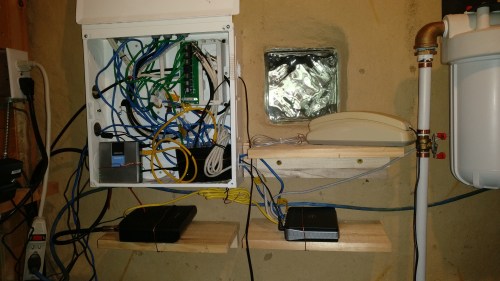
This means that we have to invest the energy to learn not just about plants and soils, but basic electricity, water systems, heating systems, nutrition and food preservation, construction, ecology, psychology, and so on, (all those things that make up the study of ethnoecology). If a homestead has solar power, one of the most basic skills for example is to learn to use a multi-meter. Everyone on the homestead needs to have the some basic skills, to more or lesser degree to enable and trouble shoot basic problems…stuff breaks…we have to deal with it.

Learning as we go along, here is a screenshot of Gord’s Energy Analysis links

Learning to wire the solar dump for the eco-hut

One of Gord’s first manuals

Dealing with battery replacement

Learning water supply for fire protection

That 10% that nobody could figure out for the heating system… read many times

Screen shot of Gord’d plumbing resources
Example: The day Gord was on the Gulf Islands and Ann was at home alone and friends were staying in the Eco-Hut, we had a water issue – water supply to the Eco-Hut shut down. Ann’s response, isolate and diagnose problem, use the multi-meter to check power, find instruction booklet for the pressure switch, and fix it…in the dark with a headlamp. Did Ann have anxiety… of course… did Ann think logically about where water comes from and what makes it go… absolutely.

Thanks to Peter Ronald for this photo from last week
Standard (outsourced) Systems vs A Permaculture Homestead
Water Systems – Rely on city water or a well pump OR take responsibility and build in resiliency and redundancy, use cistern/pond, collect rain water, and use water consciously. Skills needed – conservation methods, learn about pumps, irrigation systems, flow rates, pressure switches, valves, etc.
Energy Systems – Rely on the grid OR take responsibility and build in resilience and redundancy, collect and store energy. Skills needed – conservation methods, understanding of your energy budget, basic electrical knowledge (AC/DC), understanding of batteries and inverters and how to program them.
Food Systems – Buy food from the industrial food system OR Want to dabble in food seasonally, interested in wild meat or livestock, dairy, or take on food provisioning year round? Skills needed – understanding of your personal time limits, effective cheap and healthy processing methods, meal planning with available food, nutrition, crop planning, annual foods, perennial foods, soil building, wild foods, animal husbandry, food safe skills, etc.

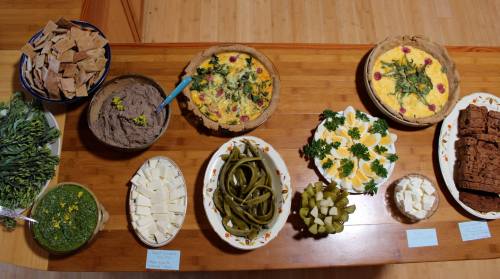
Seasonal lunch
Health – Choose to rely on the proffessional health care system (sickness treatment system) OR take responsibility for more of your day to day health needs. Skills Needed – basic first aid, natural remedies, understanding of nutrition and the gut micro-biome, the importance mental health, taking responsibility for maintaining your body and knowing your physical and mental limits.
Waste – Send it to the dump OR take responsibility for it and decrease the waste stream where possible and divert everything that can be a resource. Skills Needed – reduce waste generation, Is relying on recycling sustainable, awareness of what is waste and what is a resource, basic knowledge of toxins and pathogens and their biological and chemical degradation pathways, learn resource recovery methods, and learn to simplify your life.

Tour group learning about grey water

Pressing the Caleb Pike Heritage Park Apples

Ann’s new ensuite. I love it! Thanks Gord!

Chickens LOVE salad
Lifestyle – Go with the flow of our culture OR take control of the direction of your life. Skills needed – Honesty and time to create a life plan to know what your values and passions are and how to take the steps to create what you truly want and need (holistic life management). What do you enjoy, what don’t you enjoy, recognize when your life is more in alignment with your values, skills and aptitudes … and know hard work is OK and not drudgery.
Trying to live a simpler and more resilient lifestyle,
Ann and Gord

















 Eco-Sense