
Busy, busy, busy…but a good kind of busy. The kind of busy where the days are just not long enough and we are having so much fun. The first two weeks of our spring sales of perennial edible plants have been busy and fun with such interesting people coming by to visit and purchase plants. We are open again this Saturday from 10am – 2pm. Updated plant list here. (Note, we have sold out of Almonds…but may have more in a week if order arrives).
So who wrote what anyways? We often get asked who wrote what in our updates and more often than not people assume incorrectly. We find this quite funny. So for this update, we will start each paragraph with the author.
Here’s a typical spring day here at Eco-Sense (Sunday March 21st) with an excerpt from a Facebook post: Our day started at 3:30…we were awake, so we got up and had coffee. (Note: getting up at 3:30 is NOT normal)
Ann: Started my day with 2 hours of bookkeeping, cleaned the chicken coop (had to change clothes after…had a bad chicken shit experience), left wellbarrow of chicken shit on pathway up (too heavy for me to push…feared an even worse chicken shit experience), filled up duck food, reminded Gord to take bag of food to chickens, asked Gord to retrieve wheel barrow of shit for me (he wouldn’t hug me at this time and commented on the smears on my clothing), retrieved two duck eggs out of the pond (yes they are laying on the edge of the pond and the eggs roll in), did laundry and hung on line in the sun, made 2.5 doz pickled eggs (Yes, I washed my hands), made breakfast, lunch, and dinner (and washed corresponding dishes – Gord’s band-aids saved him from dishes…see below for why he had so many band-aids), went to neighbours to get goat milk, talked on phone for a while regarding council stuff, watered newly transplanted lettuce under hoop covers, dug out some worm castings from garden wash stand (video of wash stand and worms here), made up a potting mix, and started LOTS of seeds in the newly rat proofed greenhouse.
Typical Local Lunches:
-

- Smoothy (Squash, egg, goat milk, apple, fig), Pickle, cheese, Venison (peas, onions, garlic, rosemarie)
-
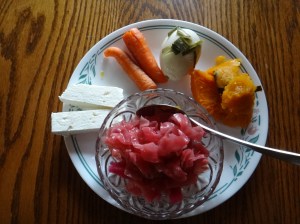
- Sauerkraut, cheese, carrot, pickled egg, squash
Gord: Spent the day potting up rootstocks and grafting. Potted 80 up last night and another 80 up this afternoon. Grafted close to fifty… little slow this morning as the fingers were cold and toes frozen… rootstock was frozen too. Peaches, almonds, apricots, pears. Tomorrow plums and then on to the easy ones… apples are by far the quickest.
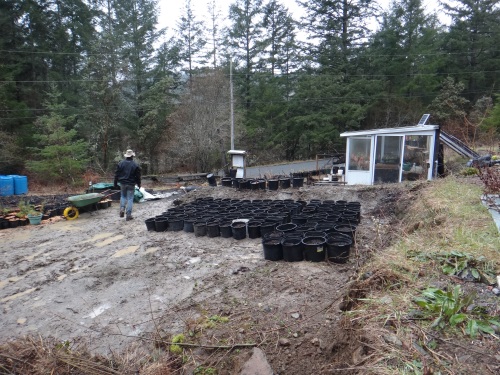
Pots ready for rootstocks and then grafting. This location is where our new simple hoop greenhouse will go.
Gord’s grafting knife is VERY sharp…hence the band-aids. Spent the evening reading council packages.
-

- Gord excavating and carefully moving Grandma’s rose
-
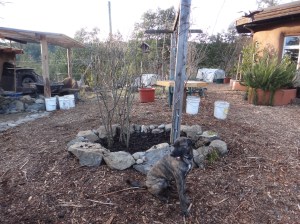
- Grandma’s Rose Bush. A better place right out front
Ann: Today (Thursday) was also an amazing day. We learned that our old farm truck that died last week is repairable…barely. Only $2,000. It died earlier in the week while we were on the Malahat highway…and we don’t own a cell phone. Ack! However, a wonderful older gentleman stopped to help us, (Gord: yes older than Ann), as we were waving our hands (but I’m still young enough to stop traffic on the highway). Woohoo…he had a cell phone…but he didn’t know how to use it. So here’s us trying to figure it out…neither of us has used a cell phone in the last 10 years. Gord fared better to me. I was completely useless without my glasses. If I was left to my own devices I probably would have walked home…I’m guessing a 10 hour hike.
So, after learning our truck was repairable, Gord continued with grafting, and I finished off and submitted our income taxes. This afternoon was the highlight of our week…we planted more perennial edible plants. Here’s our list and the locations we planted them in. We spent the prior evening making our list and walking around discussing pros and cons of different locations for each plant. An amazing amount of thought goes into the placement of each plant:
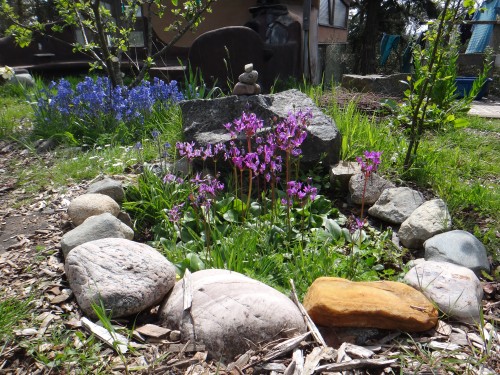
This is where Boo is buried. Boo’s headstone.
Willow Bay: next to Boo’s headstone
Silverberry: next to grey water surge tank where cottonwood used to be
2 stone pines: 1 in chicken run just inside the door where the dwarf cherry died, and 1 behind Eco-Hut just outside deer fence
Melrose apple: tbd. Possibly on Chestnut road or by maple above blueberry and tea bed
Persimmon: In Arbutus Food forest near female sea berry
Frost Peach: just downhill of Apricot
Pineapple Guava: Beside lower fuzzy kiwi’s near concrete water cistern
Medlar: just downhill of the paw paw and west of Quince in Arbutus Food Forest
Goumi: across the path from Ar Ri Rang Asian Pear.
Louquat: in special tea blueberry bed in front of Eco-Hut by pond.
Chilean Guava: by bay tree where Fennel will be removed…way too many fennel.
Evergreen Huckleberry: between a rock and a hard place (could be anywhere). Actually between the big rocks by clothes line and cob oven.
Ann: Creating a new language: It’s interesting how over the 11 years we’ve lived on this amazing rocky knoll, how we have created a language of locations that includes all kinds of landmarks. We use both natural and human created features but also historical landmarks that represent different memories attached to a specific location.


Ann: Sense of place – home: We have also learned that we are feeling more and more connected to this land the longer we nurture this land, protect this land, eat from this land, and play on this land. A huge piece of this connection is to observe the very small details. Where the wild flowers are, what birds do what where and when, how this land responds to us and what we do here, how the water flows, where the snow melts first, where the wind blows and where it’s protected, where it’s warmer, where the cold air settles, what insects eat what, what happens when we trim trees or even remove a tree to let more light in, what memories happened where and with who, and so on. It’s only from unplugging, participating, and taking time to think can one truly feel connected to place. What a gift it is to feel like home…to know one’s home…to belong to the land. One can’t help but to imagine how indigenous cultures feel about the land when they have lived so many generations connected to place.
Gord: One of those things I think we take for granted here at Eco-Sense is our observation. Observation of the state of the world and how people navigate it; observation of the land we live on and of the way food “happens”, of the soils, trees, birds, bugs, wildflowers. It is observation that powers all our decisions.
In my first marriage I always joke that I was pre-trained… that I was broken of my habit of leaving cupboard doors open. I was completely oblivious to this for years. Well I can say that Ann has trained me to pay much more attention to the details than just the cupboard doors. For a person that has been refered to as a yard sale, I have developed the skills to look after and maintain my tools much better. I still break tools… often, but when not in use I have greatly improved my tool stewardship. I have learned the skill (or perhaps the habit) to be able to stop and look at myself, my actions, and dare say my mess and actually become more responsible in my old age.
The benefits… less disposable stuff, less lost stuff, longer lifespan. This means less money spent on $60 trowels, $70 pruners, $100 wet stones, and the list goes on. It also means I have a pre-sharpened hand plane when it is needed.
Then there is Ann, whom I sometimes say is too observant. Ann has an uncanny eye for detail, both a gift and a curse. Undoubtedly her observations of the giant blue camas nestled between the wild plum and the raspberry trellis post, chocolate lillies below the seabuckthorn near the ocean spray, and by the oak near the chestnuts, various orchids like the Alaskan rein orchids behind the little den, where the white fawn lily patches are, or the old overgrown road below the chicken coop, or where the Calypso orchids are… she has saved their lives from the footsteps of many and the shovel of Gord.
Ann: This is why we have an Eco-Sense policy to stay on the trails during wild flower season (mid february – end of June). So, please if you are visiting Eco-Sense, please stay on the trails.
Gord: Our attachment to place has come with observation, and becoming familiar with the inhales and exhales of the seasons over the years, where the dormant plants are unseen landmarks we reference the land by.
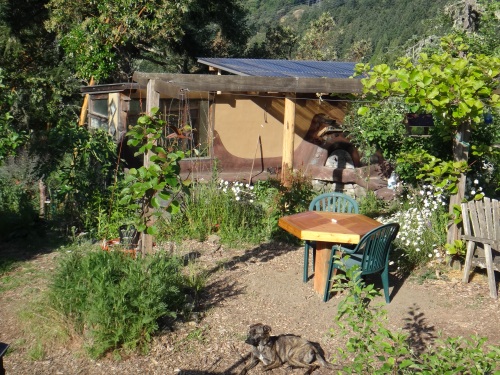 Parker (my son, now 19) also shares a keen eye of observation for the natural world. Several years back during the time when he was spending one week up here and another down in Victoria, he had just arrived home for the week. We were sitting by the cob oven. He was studying the scurrying life on the ground and the cob benches. After 5 minutes, he asked if I had gotten rid of the stair tread in the garden that had the ants nest (20 feet away)? I asked how he knew… he said that there was different ant activity. This is a gift.
When we are not observant we also lack the ability to see the art of nature, the natural patterns, the beauty… and hence we are more likely to remove the natural artwork that we see no value in, and create something in its place. Derek Jenson spoke to this wonderfully in a recent Peak Moment Video, noting that we only see human made items as works of art, yet dismiss the creations which the natural world combines so delicately – the very same things we recreate through painting, drawing, sculpture and photography. Very ironic.


So now that spring has finally arrived we get to observe the inhalation of spring, the sounds of the frogs, the arrival of 26+ species of birds and their different dances and sounds, the native bumble bees that will soon become friends to pet in their groggy morning stupor, and the surprises from last season that have reseeded and make “salad happen” in the most unsuspecting places. From Ann and I, please take the time to observe the wild and detailed art around you… complexity and diversity that boggles the mind.
-
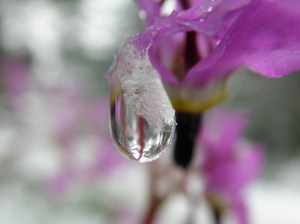
- The art of nature – a freezing water drop on a shooting star
-
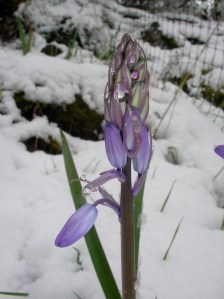
- Early to the party… or un unexpected guest
Thanks for reading. If anyone is interested in workshops or in our special tour (almost full), check out our link here.
Gord and Ann


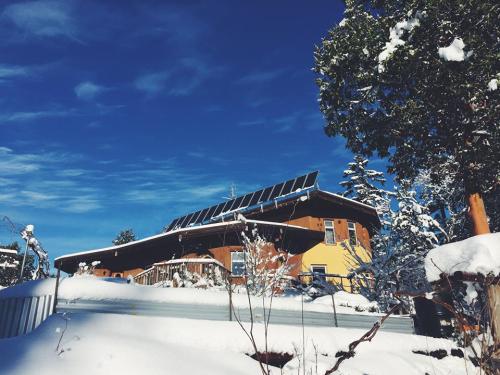
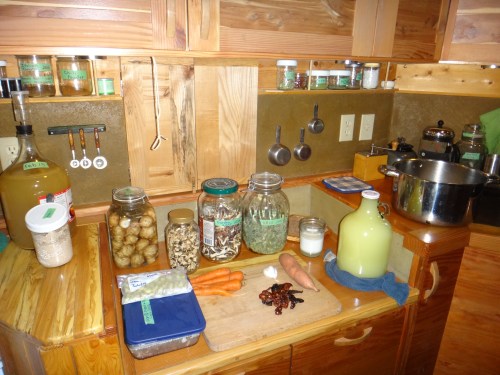 Despite the harsh and unpredictable weather this winter, it has been an abundant, tasty, and nutritious winter of food. Ann put away lots of dried foods (fruits and veggies), and fermented foods. We have lots of fresh apples, garlic, leeks, parsnips and carrots, sweet potatoes, and squash. Here’s a photo of one of our pre-packaged soups…pre assembly. Venison bone broth, fava beans, carrots, garlic, sweet potatoes, bayleaves, parsnips, squash water, dried tomatoes, dried mushrooms, dried kale, and dried zucchini. It was an AWESOME soup. Also on the counter in this photo are ginger beer on the go, kefir, sourdough spelt starter, fermenting Jerusalem artichokes, and the cheese curds and whey.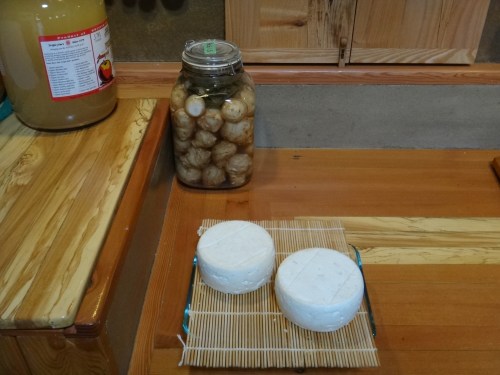
 Here’s the story: After 1 year of living well together and sharing hens peacefully, our two roosters went at it. The young one being the stronger, and our lovely gentle cuddly Beaker getting quite messed up (bloody head and missing an eye). In the morning we had to make a choice. If we let them back together Beaker would surely lose his life in a bloody battle. Beaker also had longer spurs which were damaging his favourite 3 hens. We also suspect Beaker was not very fertile as last year we had a zero hatch rate. So…to make a long story short, guess who we are eating for dinner? We looked after beaker well for 2.5 years and now he is looking after all of us. He was not frightened to die and went quickly without a struggle. RIP Beaker. (Our freezer has become an interesting place with interesting labels on glass containers…”Beaker Soup” and “Beaker with Pesto”).
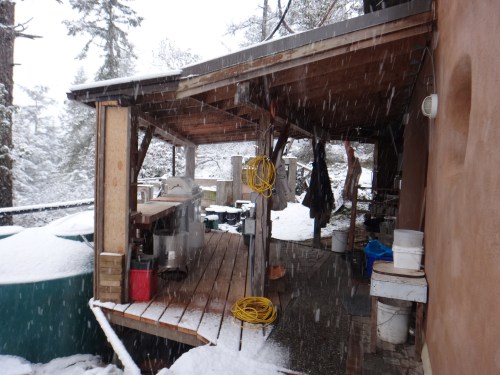
 We gave our Earth Sheltered Greenhouse a work over as the mice and rats were having a field day in there. Spent the afternoon cleaning out the mouse/rat infested greenhouse while Gord spent the afternoon digging up two sides of the earth sheltered insulated greenhouse to bury metal lath to stop the persistent rodents. Apparently the rodents like to chew through the recycled dock foam insulation buried in the earth to gain access to summer tomatoes, peppers and newly planted seeds. What a mess. Then it started to rain. Found numerous mummified things…ack. So happy to have the greenhouse all cleaned up and rodent free…for now.
 Our Positives



 Eco-Sense