Special Notice: Meet a damn great guy!


Join Andy MacKinnon and a couple other fine folks for a tea party

Not a fundraiser, not a rally, not a volunteer recruitment drive; just a casual opportunity to gather with some of your neighbours and get to know our riding’s Green Party candidate, Andy MacKinnon.

Think of it as a job interview for Andy: an opportunity to learn about the principles that drive him, to ask him about issues that matter to you, to get your questions about the B.C. Green Party platform answered and to share your concerns and your hopes for our province.

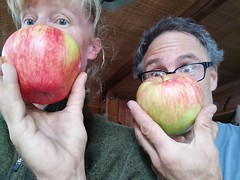
Tea (with and without caffeine), coffee, Pattie’s own apple juice and goodies (with and without gluten) will be provided.

Note that Andy is not in our (Ann and I) riding, but has become someone we admire and respect through local politics.   If anyone is asking who is Andy MacKinnon, just go to your bookshelf and pull out that field guide called Plants of Coastal BC. Andy is one of the authors.
Andy is also a professional biologist AND a councillor with Metchosin.

Meet Andy MacKinnon, Green Party Candidate foandy-mackinnon-green-partyr Esquimalt-Metchosin

When: Friday, April 21, 7:00–9:00 p.m.
Where: 5311 Rocky Point Rd., Metchosin (at northeast corner of Montreul Heights)
RSVP: By responding to pattie@pacificcoast.net or calling 250-478-3319

Hope to see you there!

Gord, Ann and Pattie

p.s. For those who like doing homework, you can find more information here:

http://www.bcgreens.ca/esm

http://www.bcgreens.ca/platform

A blast from the past


After finally stopping for a moment to look back at our history in this wacky Eco-Sense adventure, we’d thought it would be fun to share the odd old post… here is one from just over 10 years ago.   No pretty pictures back then… we didn’t know how to do that (that stuff is complicated you know!).   Don’t despair this time around we have added pictures.

As I read through this update from many years ago, I smile and then I tear up… Angela Evans, mentioned in this update, a friend, has since passed away – but her favourite sweet peas grace the front of our home, our khaki campbell duck flock are collectively named the sweet peas, and we have Angie duck.    We miss you Angela

November 2007 Update

Filed under: Eco-Sense Updates eco-sense.ca @ 7:58 pm


We left you last month with a cliff hanger. Although the car died we still have the van. Our remaining vehicle has 450,000 kms on it, and is meant strictly as the work thing to tow the trailer up the driveway. It looks like a work thing; it is bruised, battered and filthy just like Gord, and they are both starting to complain. The difference is that Gord is reliable but the van is not. Ann is complaining too because it’s too filthy to transport groceries in.

The vehicle vs. values saga

What do you do when hard work and luck places you where you want to be, but society and cultural pressures tell you to ignore your values and get back in the box?

As many of you are aware we have shared custody of the kids with alternating weeks. What were to happen if we refused to buy a vehicle because of conflict with our values? What if we argued that there were no good alternatives available yet to transport kids? What if we had no bus service? For two years we have tried to change the kids’ school as was agreed to when we moved here. Currently, we have a two and a half hour daily drive to and from school twice per day which accounts for most of our driving. What if we biked to the closest bus route and sent the kids off to school for an hour long bus ride each way? Lots of questions…No answers!

The only answer is… Too bad… you have to uphold your responsibility to transport the kids to school. The courts are not even close to being able to make a decision based on the triple bottom line. Interestingly we have spent the last two years attempting to discuss climate issues, equal family involvement, kids’ school friends, reduction of greenhouse gases, environmental education, kids’ schedules, and commuting costs. We are saddened and left wondering what is worth fighting for. Do we allow our culture to determine that we go out and purchase a greenhouse gas spewing dinosaur? Can we wait for the government to allow electric vehicles? Could we even afford one?

Interestingly the Federal government has told one of the Canadian based electric vehicle makers, that despite them meeting the federal guidelines, they still can’t sell in Canada, as the federal government has plans to review their guidelines. Something is a little stinky here!

The Electrical Code

Our lucky day…we just got a new electrical inspector assigned to our building. He is only into the job two weeks and he gets our house. Our thoughts were “poor bugger”. Our electrician gently peppered him with questions, and he went for his notebook. The inspector spent half of his two hours getting a tour of the systems, an introduction to sustainability, and learning how deficient the electrical code really is when it comes to energy conservation.

The inspector has had to learn a lot really quick. We learned that the electrical code is kind of like the Bible…open to interpretation.

We had expected that our living (circle) room would have to have AC outlets built into the back of the cob all the way around the seating areas. When we asked what he would like to see he said “well it looks like this really is a cozy spot to read. Why would you want to put plug outlets into built in furniture?” That was supposed to be our line! Common sense prevailed.

Things were stalled here while we waited for the feedback from the electrical inspector on all the items that make our home different from the norm. What will he say about the DC outlets, the 24 volt LED lights (that are not CSA approved), the 24 VDC pumps that are not CSA approved, screw in AC Edison base light fixtures to be used for DC bulbs?

Two weeks later. All is ok… just don’t put in regular AC switches for the DC lighting. There is a good reason for this, as AC voltage cycles at 60HZ, meaning there is little to no arc when a switch is flipped, unlike DC. We need to use a switch with a stronger spring to ensure that the connection of the circuit is broken, rather than an arc causing it to fuse and stay connected.

Insurance

We had Ted Hill, the editor from the Goldstream Gazette, here the beginning of the month. It was interesting to watch this fellow show up to do a story that he felt slightly responsible to do, but not too sure about what the story should be. Over a two hour period, we saw Ted’s eyes open wider, and the laughs and amazement increase, with the final point of interest being that our insurance will be based on buildings that exist in the UK that are several hundred years old (older than Canada)!

Pattie Whitehouse, who used to write all our stories for the Goldstream Gazette, was let go when Black Press took over. It’s amazing how hard it is to get news coverage in our own community. We are still waiting for the story in the Gazette to come out.

Toilet Training

It wouldn’t be complete for a month to go by with out talking about the toilet, so here it goes. We put out a call for a good used toilet to temporarily install in our bathroom to comply with code. After receiving offers for six such old toilets it became clear that in order to comply with the building code we had to install a LOW flush toilet. Now don’t get us wrong…this is a great law…but for us, who plan on using a NO flush toilet it just doesn’t make any Eco-Sense.

So instead of this being a problem, we are going to have some fun with this…we can either cry over stuff like this or laugh. So here is the tentative plan for next February.

Neville, a friend here in the Highlands, has a company in Victoria called Heritage Office Furnishing, which will donate a new low flush toilet to the Highlands Heritage Park Society (Pike House). Bob McMinn from this society (and the first mayor of the Highlands) will loan this toilet to us to install and fulfill code requirements.

We are then holding the first ever ‘Celebrity Flush’ event targeted at celebrities, politicians, and anyone who supports what we are doing. The goal is to support sustainability and show opposition to the crazy rules that stand in the way of sustainable development. Participants pay $50 to pee into this new low flush toilet. No, this is not a pissing contest!

Proceeds will be donated to the Highlands Stewardship Foundation to continue their good work with monitoring ground water and educating us in its use. The slightly used low flush toilet will then be installed in its final resting place on the Pike house grounds complete with a story board of how it came to be.

Sustainability is FUN! Thanks to Pattie, Neville, and Bob for their insight, humour, and help. Looking forward to even more community input (pun intended).

And the Heating … AGAIN!

Yet one more time we look at heating. From purely solar, to generator back-up, then wood gasification, then to electrical, on to air-to-water heat pumps, then toying with bio-diesel, then back to more solar, and finally wood gasification. Who said ignorance was bliss!

Here is our brief summary of our rational, and believe me it is brief to summarize nine months of research into a few sentences.

Purely solar would mean 240 evacuated tubes for December and January demand, while only 60 tubes seven months of the year. This translates into an extra $18,000. Yikes!

Generator: A diesel genset has efficiency losses from transferring fuel into both power and excess heat. We did not want to rely heavily on a fuel (biodiesel or diesel) nor be inefficient. Ann can’t stand exhaust fumes either.

Air to water heat pump: We found an amazing heat pump made in Germany by Dimplex with a CoP (coefficient of performance) of 3.9; this means for every 1 Kw of energy fed into the system 3.9 Kw of heat are extracted. We almost went this route but would need to add more PV panels as its rated capacity was for 1.9 Kw.

Biodiesel direct hot water system from ITR. ITR did the testing, and their smaller Hurricane II was a good fit, but their larger Oasis was CSA certified. We again second guessed ourselves as to relying on fuel availability. Ann still didn’t want to breathe any exhaust.

Grid fed electric element. NOT!

Wood gasification. We finally purchased the wood gasification boiler. We had a choice of Greenwood, HS Tarm, Eko, and Wood Gun. Each gasification burner has different requirements depending on your setup. We decided on Alternate Heating Systems’ Wood Gun.

Wood Gun

The Wood Gun has been made for 27 years, same design, simple, repairable, doesn’t require a large water tank to operate efficiently. It basically heats wood allowing the gases to be released and be burned in a secondary chamber reaching between 1800-2000 degrees F. The boiler is immersed in 60 gallons of water, where in which it transfers heat through a coil to our 120 gallon hot water tank. These units are pretty much smokeless scoring big points with Ann.

We “learn” then we “do”

We are often asked how we learned what we are doing. What is it that makes us different? Not much! We just learn, and then we do. We’re not scared of failure which frees us up to be creative. We are also not as attached to a particular outcome and will work with and accept how things evolve. Life is not about the best decision or perfection.

Accomplishments for the month!

Ben and Ann have completed most of the exterior brown coat plastering. Tough work with cold hands.

Gord and Ben also finished putting in the hydronic heating tubes upstairs and the earthen floor on top.

Angela Evans (who did some tours here this past summer) came by to spend the day drawing some beautiful creatures on our exterior cob walls. We hope to incorporate these into some relief work on our home.

BC Hydro, after a tour of course, hooked up and connected the grid intertie. We are number 16 in the province.

Our plumber and electrician (Byron and Mike) have worked hard to give us temporary heat running though the floors. There is lots of moisture to push out to dry everything and start to warm up the place.

We cleaned up a bit, (Ann let her hair out of the ever present ponytail), and swept the house in preparation for the Knowledge Network. They will be back one more time in January to do the final shoot. Almost an entire day for a few minutes of footage.

Creativity Strikes

We have experimented with packing crates, plywood, old 24’s and some of our own wood. This rearrangement of old and new wood from forests past and present has created a kitchen and a composting toilet. Not in the same room of course. The kitchen has counters that are made of many types of wood including; gorgeous black walnut (old packing pallet); a lowered bread making counter of old growth Doug Fir ripped from 24’s from an old school with some spalded Arbutus from last years early snow storm; some old trestle from Bear (Bare) Mountain for the raised bar above the sink, and some of our own Fir from the land arranged in an alternating pattern of grain. All was finished with a combination of Tung oil and Osmo hardwax oil. A gorgeous and unique work of art! We love to tell people that our kitchen is made out of old packing pallets… they nod their heads and smile… with no clue to the beauty created.

We had hoped to be into the house for Christmas, but have accepted yet another winter in the trailers. This has been tough on all of us but we joke and hope for the weather to be less stormy than last year.

Cheers,
Ann and Gord

A Little Edgy, Very Marginal


A little Edgy and very Marginal.  This may be how Ann describes Gord at the best of times, but hopefully after reading this update, a bit more light is shed on the importance of being marginal.

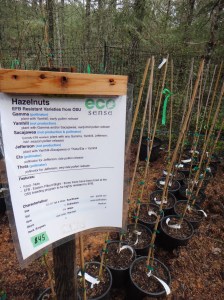
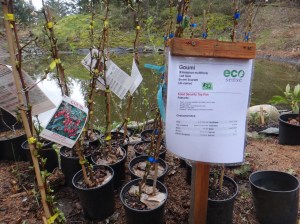
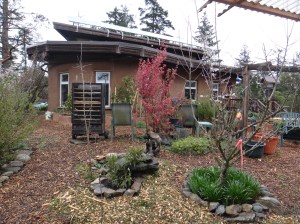
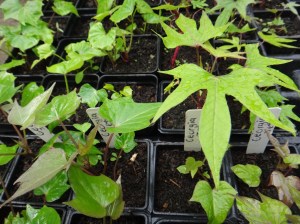
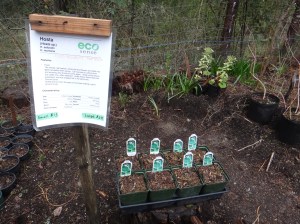
DSC02860But first this advertisement from our sponsor (haha)…We have lots of perennial plants for sale here at Eco-Sense…everything from sweet potatoes to Goumi’s, figs, edible hosta’s, currants, grapes, NUTS, pears, plums, apples, apricots, sea berries, asparagus, edible day lily, saskatoons, and kiwi’s…just to name a few.  We even have some perennial vegetables and cover crops.
DSC02851

Daffodils – 3 weeks late

Next Open farm day:

Saturday April 8, 2017 from 10am-2pm

Eco-Sense homestead is open to walk around and/or buy perennial plants

See cob buildings, chickens/ducks, food forest, perennial and annual gardens

The Eco-Hut (example of a tiny home)

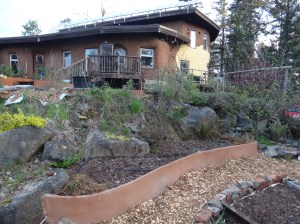
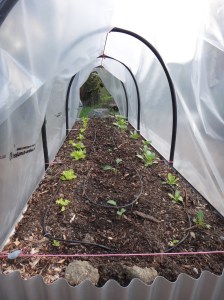
Raised garden beds including Galvalume and Concrete Curvy beds

Your questions answered!

Now back to the blog post:  Ann and I straddle an interesting intersection between the mainstream and the “other” stream, call it what you may.  For those of us straddling multiple realities, it’s “crazy making” and it’s tough to balance co-existing in both.  Anyone else have this same experience?  However, there is an energy that is derived from navigating these worlds simultaneously.  This energy inspires Ann’s seemingly endless rants (of which I bear the brunt of over morning coffee – yes we still drink coffee), as she observes the details of the parallel realities, accepts the feedback, and then neglects to self-regulate her responses.  (See last weeks post on Regulatory Feedback).

Edges of the economic system

Living a 3-Thirds lifestyle means we split our time;  volunteer 1/3rd, work for income 1/3rd, and follow our passions 1/3rd.  What this means is that we really don’t have the lifestyle to be a good employee and we definately do not maximize the financial earning potential of our education…or save $$$ for retirement.  We don’t fly, rarely eat out, don’t have a cell phone and we don’t embrace/support the growth economy (non-plant growth economy that is).  This places us at the edge of meeting our basic needs, but marginalizes us from those folks who have lots.  Yet the benefits of being on this edge allows us to maximize diversity and thrive.  This time allows us to think and process information and to be a bit more in control of our lives.  We are not slaves to the system.  Some of this is luck, some of this is our privilege, and some of this is hard work.  We have become really hard working generalists that can adapt, swoop and weave, and navigate a rapidly changing world and much of it we do on our own terms.

Edges of lifestyle choices

Do I dare say we don’t use soap anymore?  (For years now, really)  And dare Gord say that he brushes his teeth less?  Gross!  (If you don’t eat sugar or much starch, the mouth bacteria is VERY different).  This is an example where most folks would recoil in disgust without any knowledge of the science and benefits of having a natural ecosystem biome doing those tasks for us, and much better than the chemicals most of us slather our bodies in.  If you’re not completely grossed out…keep reading.  (Note we brush our teeth daily, but only about once per week with a natural toothpaste).

Soap kills and washes off both bad and good bacteria and nourishing oils.  When we wash and scrub our bodies with harsh soaps, we remove the bacteria that make our own lanolin, thus our skin dries out and voila we have more exczema, dermatitis, and slower wound healing.   Just like any ecosystem, the more biodiversity there is, the healthier it is… and next to Gord’s (non-stinky) armpits, nothing smells better, except perhaps some nicely aged compost.  The best way to “re-wild” ones body is to gradually wean yourself off of the soaps and other products and your skin will adjust to a NON-STINKY biome.  We found that in the beginning we still needed a bit of odour control and used coconut oil in the pits.  It’s still important to shower with warm water to gently exfoliate and clean the skin.  (2-3 times per week).  We consider ourselves clean and tidy people…but we are FREE of most of the chemical products.  (Ann still uses shampoo and conditioner).

There is a reason why this works and why the same science has been pushing for natural births, for the very purpose of populating the new born baby with an ecosystem.  Russian phage therapy (using beneficial bacteria to fight infection), has succesfully accomplishing this task by enhancing the biodiversity in the wound.  The issue of antibiotic resistant bacteria is a non-issue with this approach whereas in North America or Europe excessive antibiotic use has caused a huge issue.

Edges…everywhere.  This is where abundance happens.  There is simultaneously more sharing AND more competition, more movement of nutrients and ideas, more activity, more species, and in human culture, more fun.  Forest edges, intertidal zones, wetland edges, cropland edges, social edges, and ideas edges.  Life can be tough in these edges and they often require species/individuals adapted to rapidly changing conditions, harsher environments, and species that are often generalists.  This also applies to those of us living in ways that straddle different ideologies.  We have to be able to swim and thrive  in many different waters and when required, retreat to safety.

DSC02872

Edges of the gardens

Gardens are no different.  If you grow a mono-crop, your plants are more prone to pests and disease, especially as there is no community in the soil to share and swap nutrients… as they all compete for the same things.  Our gardens are wild and crazy, and healthy… and the edges even more so.  At this time of the year, Ann scavenges new starts of broccoli, kale, parsnip, chard, tomatillo, tomatoe, parsley, leek, and the list goes on.  These edges produce many of the new plants, rather than us having to sow seeds ourselves… a big time saver and guess what… these plants are superior to seeds we have started.  The reason, well that is another nerdy talk on epigenetics.

Edges of the forest:  I often think to how hominids evolved, they were on the edges of the forests and savannah.  They had opportunity in both, and stood up to the challenge.  (Hehehe).  The edges of forests offer more diversity, more pressures from competition, more opportunities, more varied climates and sunlight.  More varieties of bugs and birds exist, more varieties of soil types and soil life exists.

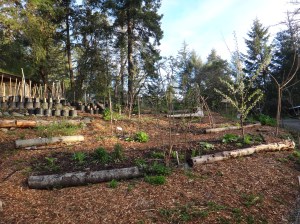
The Land here at Eco-Sense:  We straddle this concept in that we live on a previously impacted rocky knoll of land; land that has slopes on all sides (North, East, West, and South) giving rise to many different niches and microclimates.  This land has been burned in the past from forest fire and has road scars cut in from prior logging.   There are plenty of margins, and we are learning how to use and manage them AND to leave them alone to regenerate, and slowly experiment with increasing biodiversity.  One lesson that has stuck out for us is that book learning doesn’t come close to the learning from living on the land, observing the life, the soils, the wind, the water and letting the land teach us what we are willing to learn.

Seasonal Diets: Our internal gut micro-biome also thrives from diversity…and especially from a seasonal local diet.  Eating many different foods feeds many different species of bacteria resulting in more diversity.  However, if we just eat the same foods year round, eventually a small number of gut bacteria species will dominate and take over. This is why it’s critical to eat seasonal foods to keep our gut micro-biome on the edge.  Taking this one step further we can also see how eating bacteria and food from our home region also sets us up to have a more locally adapted micro-biome.  The study of gut micro-biomes is telling us that one of the primary drivers of overall health, disease resistance, neurological disorders, and immune function is the diversity of gut bacteria.

As above, So below, and even more so in between.  Our bodies ARE in between.

Food systems:  Ann’s list of 7 major contributors to poor gut health:

  1. The herbicide glyphosate (Roundup), found on most food (used on GMO crops AND as a pre-harvest desiccant).  Glyphosate is antibacterial.  http://sustainablepulse.com/2016/10/12/pesticide-experts-release-shocking-review-of-global-glyphosate-damage/#.WOf4OBiZORv
  2. Diets high in refined carbs (processed white flour, sugar, processed foods) feeds a mono culture that outcompetes good bacteria.
  3. Diets low in fibre.  Good bacteria need to eat fibre.
  4. High use of antibiotics (internally and externally).  Kills bacteria
  5. Low exposure to soil microbes (too sterile).  Eat some “clean” soil, play in the soil.
  6. Non seasonal diet.  variety of food changing through the year.
  7. AND non-vaginal births.  Nothing like a trip out the birth canal to coat the new baby in some healthy bacteria.

We could go on…and on…and on…but we better quit.

Ann and Gord


Regulatory Feedback


With a blog title like “Regulatory Feedback” one could expect an update on our council policy work or perhaps the current state of science on self reinforcing feedback loops in the climate system…or perhaps even personal relationships and patience.   Maybe it will be some of all of this woven into a muddy mess where our public feedback would be “what the heck are they trying to say anyways?”  But before this, a quick notice about the nursery.

Sales of Perennial Edible Plants:  Saturday April 1, from 10am-2pm.  Special featured plants this week are:  Full list here with prices

Ann and I are sometimes at odds with each other when it comes to decisions…aren’t all couples?  Even at the council table it is not usual for us to vote differently.  One of the hardest things in a relationship is to self regulate and listen to feedback.  Our culture has generally trained us to push back and resist feedback while becoming emotional and effectively shutting down our capacity to hear.

(Ann) It seems that collectively, much of humanity has lots the ability to receive feedback from each other, from other cultures, and most importantly from nature.  Feedback is absolutely everywhere… IF we pay attention and IF we are willing to hear it, see it.  Our culture is by and large oblivious to feedback, but if we do hear it, our egos are almost always in the way.

(Gord) Anyways, always start positive… right?   Ann gives great feedback.  Last week in our post I indicated Ann was very observant?   Wow – two positives.   (Ann) In our shared desire to install “Eco-Sense” systems that integrate food, water, energy, lifestyle to create more biodiversity, more carbon sequestration, more resilience, and more abundance, we inevitably have an impact upon the land.  (Gord) In this process, my desire is usually to “get ‘er done”… plant more, plant now.  This results in rapid changes.  (Ann)  I’m more like storm water management with Gord being the storm water…Slow it Down, Spread it out, Sink it in.

(Gord) Tears and arguments have resulted from long discussions around expanding the gardens or gaining more sun from tree thinning.  Let’s just say that we are stronger because of hearing each other and finding common ground (I hope Ann does not edit this).    Ann has been the one to stand up for those without voices.  (Ann’s edit – they actually have voices, they just speak another language – I hope Gord doesn’t edit that out).  Non-human living beings created and shaped this land long before we arrived.  Ann has been the one to hear the feedback and self regulate our activities, and slow the process down so that we can all adapt to the changes.

(Ann) The benefits of this are many.  The first, being, that this gives us a chance to observe nature’s feedback.  Another, is that slower change allows the ecosystem to adapt more incrementally.  Also, we have both learned more about ourselves, each other, and how to hear nature.  If we are designing with nature as our architect (as we say on all our tours), then we better listen to what our architect has to say.  A final benefit is that we have learned to be patient… what are we in such a hurry for anyways?

(Gord) I have learned to appreciate the wild and wooly edges that are as unkept as my beard and workshop, and see the benefits.  The piles of broom from two years earlier have housed mice (which feed owls) and now house bumble bee colonies (that are the early pollinators).  The snowberries and ocean spray that I struggle to have affection for are alive with bees and other pollinators drawing denser populations to the gardens all the while feeding the swallows and other song birds.  History is also tied to place due to the spiritual and medicinal importance the snow berries are for our First Nations.

We need to steward and participate in this land.  We can’t do that if we simply impose ourselves upon it in an abusive relationship.  We need to hear the feedback in order to fall in love with this land.  The same goes for the entire planet.

Nature is giving us a lot of feedback…who’s listening?
Here’s a very short and beautiful video.  

Gord and Ann


Observations and Connection


Busy, busy, busy…but a good kind of busy.  The kind of busy where the days are just not long enough and we are having so much fun.  The first two weeks of our spring sales of perennial edible plants have been busy and fun with such interesting people coming by to visit and purchase plants.  We are open again this Saturday from 10am – 2pm.  Updated plant list here.  (Note, we have sold out of Almonds…but may have more in a week if order arrives).

So who wrote what anyways?  We often get asked who wrote what in our updates and more often than not people assume incorrectly.  We find this quite funny.  So for this update, we will start each paragraph with the author.

Here’s a typical spring day here at Eco-Sense (Sunday March 21st) with an excerpt from a Facebook post:  Our day started at 3:30…we were awake, so we got up and had coffee.  (Note: getting up at 3:30 is NOT normal)
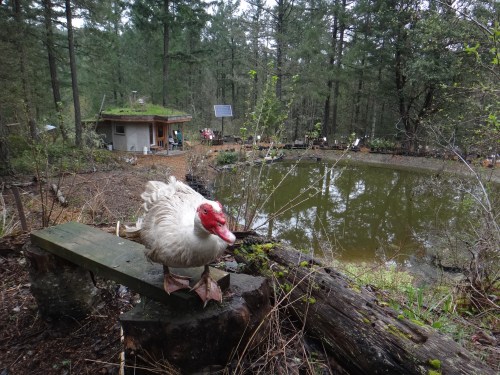
Ann:  Started my day with 2 hours of bookkeeping, cleaned the chicken coop (had to change clothes after…had a bad chicken shit experience), left wellbarrow of chicken shit on pathway up (too heavy for me to push…feared an even worse chicken shit experience), filled up duck food, reminded Gord to take bag of food to chickens, asked Gord to retrieve wheel barrow of shit for me (he wouldn’t hug me at this time and commented on the smears on my clothing), retrieved two duck eggs out of the pond (yes they are laying on the edge of the pond and the eggs roll in), did laundry and hung on line in the sun, made 2.5 doz pickled eggs (Yes, I washed my hands), made breakfast, lunch, and dinner (and washed corresponding dishes – Gord’s band-aids saved him from dishes…see below for why he had so many band-aids), went to neighbours to get goat milk, talked on phone for a while regarding council stuff, watered newly transplanted lettuce under hoop covers, dug out some worm castings from garden wash stand (video of wash stand and worms here), made up a potting mix, and started LOTS of seeds in the newly rat proofed greenhouse.

Typical Local Lunches:

Gord:  Spent the day potting up rootstocks and grafting.  Potted 80 up last night and another 80 up this afternoon. Grafted close to fifty… little slow this morning as the fingers were cold and toes frozen… rootstock was frozen too. Peaches, almonds, apricots, pears. Tomorrow plums and then on to the easy ones… apples are by far the quickest.

DSC02818

Pots ready for rootstocks and then grafting.  This location is where our new simple hoop greenhouse will go.

Gord’s grafting knife is VERY sharp…hence the band-aids.  Spent the evening reading council packages.

Ann:  Today (Thursday) was also an amazing day.  We learned that our old farm truck that died last week is repairable…barely.  Only $2,000.  It died earlier in the week while we were on the Malahat highway…and we don’t own a cell phone.  Ack!    However, a wonderful older gentleman stopped to help us, (Gord: yes older than Ann), as we were waving our hands (but I’m still young enough to stop traffic on the highway).  Woohoo…he had a cell phone…but he didn’t know how to use it.  So here’s us trying to figure it out…neither of us has used a cell phone in the last 10 years.  Gord fared better to me.  I was completely useless without my glasses.  If I was left to my own devices I probably would have walked home…I’m guessing a 10 hour hike.

So, after learning our truck was repairable, Gord continued with grafting, and I finished off and submitted our income taxes.  This afternoon was the highlight of our week…we planted more perennial edible plants.  Here’s our list and the locations we planted them in.  We spent the prior evening making our list and walking around discussing pros and cons of different locations for each plant.  An amazing amount of thought goes into the placement of each plant:

DSC02320

This is where Boo is buried.  Boo’s headstone.

Willow Bay: next to Boo’s headstone

Silverberry: next to grey water surge tank where cottonwood used to be

2 stone pines: 1 in chicken run just inside the door where the dwarf cherry died, and 1 behind Eco-Hut just outside deer fence

Melrose apple: tbd.  Possibly on Chestnut road or by maple above blueberry and tea bed

Persimmon:  In Arbutus Food forest near female sea berry

Frost Peach:  just downhill of Apricot

Pineapple Guava: Beside lower fuzzy kiwi’s near concrete water cistern

Medlar:  just downhill of the paw paw and west of Quince in Arbutus Food Forest

Goumi: across the path from Ar Ri Rang Asian Pear.

Louquat: in special tea blueberry bed in front of Eco-Hut by pond.

Chilean Guava: by bay tree where Fennel will be removed…way too many fennel.

Evergreen Huckleberry:  between a rock and a hard place (could be anywhere).  Actually between the big rocks by clothes line and cob oven.

Ann:  Creating a new language:  It’s interesting how over the 11 years we’ve lived on this amazing rocky knoll, how we have created a language of locations that includes all kinds of landmarks.  We use both natural and human created features but also historical landmarks that represent different memories attached to a specific location.

Ann:  Sense of place – home:  We have also learned that we are feeling more and more connected to this land the longer we nurture this land, protect this land, eat from this land, and play on this land.  A huge piece of this connection is to observe the very small details.  Where the wild flowers are, what birds do what where and when, how this land responds to us and what we do here, how the water flows, where the snow melts first, where the wind blows and where it’s protected, where it’s warmer, where the cold air settles, what insects eat what, what happens when we trim trees or even remove a tree to let more light in, what memories happened where and with who, and so on.  It’s only from unplugging, participating, and taking time to think can one truly feel connected to place. What a gift it is to feel like home…to know one’s home…to belong to the land.  One can’t help but to imagine how indigenous cultures feel about the land when they have lived so many generations connected to place.

Gord:  One of those things I think we take for granted here at Eco-Sense is our observation.  Observation of the state of the world and how people navigate it; observation of the land we live on and of the way food “happens”, of the soils, trees, birds, bugs, wildflowers.  It is observation that powers all our decisions.

In my first marriage I always joke that I was pre-trained… that I was broken of my habit of leaving cupboard doors open. I was completely oblivious to this for years.  Well I can say that Ann has trained me to pay much more attention to the details than just the cupboard doors.    For a person that has been refered to as a yard sale, I have developed the skills to look after and maintain my tools much better.  I still break tools… often, but when not in use I have greatly improved my tool stewardship.  I have learned the skill (or perhaps the habit) to be able to stop and look at myself, my actions, and dare say my mess and actually become more responsible in my old age.

The benefits… less disposable stuff, less lost stuff, longer lifespan.  This means less money spent on $60 trowels, $70 pruners, $100 wet stones, and the list goes on.  It also means I have a pre-sharpened hand plane when it is needed.

Then there is Ann, whom I sometimes say is too observant.  Ann has an uncanny eye for detail, both a gift and a curse.  Undoubtedly her observations of the giant blue camas nestled between the wild plum and the raspberry trellis post, chocolate lillies below the seabuckthorn near the ocean spray, and by the oak near the chestnuts, various orchids like the Alaskan rein orchids behind the little den, where the white fawn lily patches are, or the old overgrown road below the chicken coop, or where the Calypso orchids are… she has saved their lives from the footsteps of many and the shovel of Gord.
Ann: This is why we have an Eco-Sense policy to stay on the trails during wild flower season (mid february – end of June).  So, please if you are visiting Eco-Sense, please stay on the trails.

Gord: Our attachment to place has come with observation, and becoming familiar with the inhales and exhales of the seasons over the years, where the dormant plants are unseen landmarks we reference the land by.

DSC02433Parker (my son, now 19) also shares a keen eye of observation for the natural world.  Several years back during the time when he was spending one week up here and another down in Victoria, he had just arrived home for the week.  We were sitting by the cob oven.  He was studying the scurrying life on the ground and the cob benches.  After 5 minutes, he asked if I had gotten rid of the stair tread in the garden that had the ants nest (20 feet away)?  I asked how he knew… he said that there was different ant activity.  This is a gift.

When we are not observant we also lack the ability to see the art of nature, the natural patterns, the beauty… and hence we are more likely to remove the natural artwork that we see no value in, and create something in its place.  Derek Jenson spoke to this wonderfully in a recent Peak Moment Video, noting that we only see human made items as works of art, yet dismiss the creations which the natural world combines so delicately – the very same things we recreate through painting, drawing, sculpture and photography.  Very ironic.

So now that spring has finally arrived we get to observe the inhalation of spring, the sounds of the frogs, the arrival of 26+ species of birds and their different dances and sounds, the native bumble bees that will soon become friends to pet in their groggy morning stupor, and the surprises from last season that have reseeded and make “salad happen” in the most unsuspecting places.     From Ann and I, please take the time to observe the wild and detailed art around you… complexity and diversity that boggles the mind.

Thanks for reading.  If anyone is interested in workshops or in our special tour (almost full), check out our link here.

Gord and Ann