Risky Business


Before the update… which we think is particularly pertinent at this time during the hurricanes, fires, floods, droughts, Trump and other horrible world events, we risk losing you, the reader, by saying…

HEY!    Nursery is open Saturday Sept. 30 from 10am – 2pm
60 of our Grafted apple trees are now in inventory and ready to go.  

IMG_20170916_090533

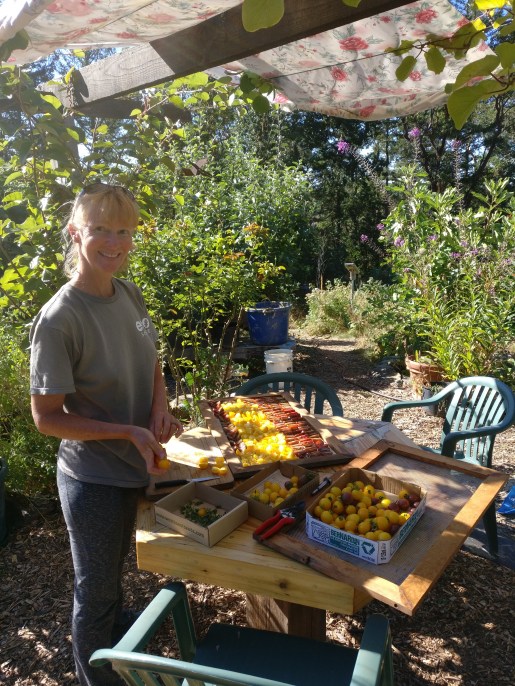
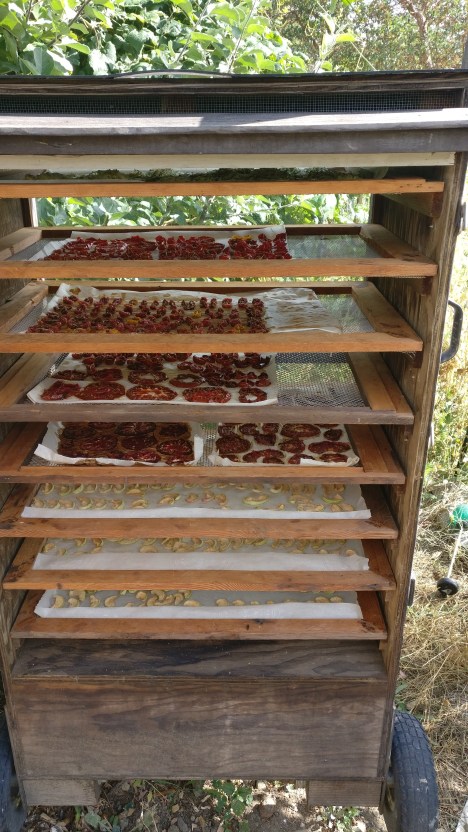
Radical Homesteading!  Tomatoes ready to dry.  In late September I start in the oven and then move to the solar dryer.

Grafted in April 2017, the growth and health has been extraordinary. Over 5 feet of new growth.

Life itself is risky business let alone being married to Ann.   For Gord, learning the art of risk assessment and adaption planning has been critical to his survival on many occasions.   As with all strong marriages, outside of adaptation strategies, mitigation skills rank up there with food, shelter and beer.   This week offered us the opportunity to see others share their experience, knowledge and research on all the above at the Livable Cities Forum: Advancing Low carbon Resilience.  So you can just  imagine the comfort we felt being immersed in a conference full of engineers, insurance professionals, chief resiliency officers, city managers, planners, and policy analysts from three levels of government discussing… how to get along in the face of risks posed by climate change.

Later in the week Gord changed gears from risk avoidance to risk taking, in the form of speaking engagements.  One presentation topic was spawned from the conference from the unavoidable question that arises as folks mingle, “So, what do you do for a living?”.  Gord hears that and fear shoots through his veins.  What do you say?  How much time do they have?  How can I be concise and coherent?  Gord usually defaults to the inappropriate… “I live in a mud house and I shit in a bucket.”

The risk here is that your either really quickly alienate yourself, or really quickly have another person that wants a private tour.    For the Oak Bay Probus Club, Gord had to be a little more formal and tidy in answering that question… taking 50 minutes to explain that really he is somewhat unemployable because he doesn’t have a trade certification,  a MA or PhD, isn’t a registered professional, and is an elected official in the smallest community in the CRD.   Needless to say the group was wonderful and supportive, with lots of questions on topics of EROEI (energy return on energy invested), Solar PV and their ecological footprint in their manufacturing, economics, structural engineering of the Eco-Sense home, if Ann can be cloned, and if we sleep.   Upon reflection, Gord wonder’s why they didn’t ask about cloning him?

The other presentation to the Mill Bay Garden Club… well lets just say Gord was inappropriate when someone in the audience asked “How do you protect your nuts?”  From risky to risqué.

Risk really is one of those items that most of us want to avoid.  After all feeling secure is so much easier.  We attended the Liveable Cities Forum in Victoria, a conference where we were only two of three elected officials in attendance amongst a whole host of people that take fire, flood, climate change and resiliency really seriously.  Many of these folks have to because they have had to respond to disasters in their own cities (Calgary, Montreal, Toronto).  We came away feeling more energized than we ever have, and summarized our workshops and corresponding take away points in 3211 words… each.  Yup … we both wrote up our reports and when we had each completed them we each were at 3211 words.  Talk about a marriage made in heaven.

Links to our summaries:

Ann’s Summary of LCF2017
Gord’s Summary of LCF2017

IMG_20170924_123524

Yummy lunch including “Escape Pods” – Fermented garlic scapes and radish pods – YUMMY.  And Yes, Gord eats faster than Ann

You don’t want to read a novel you say… no problem, here is an extremely quick synopsis.

We’re screwed.  Or in the words of Barbara Kingsolver in her recent interview on CBC‘s The Current, “Because climate change is really, really terrible, let’s face it. This is not going to end well.”  But, there is a hell of a lot we need to do.  Seriously, if you are interested in this topic and what can and IS being done, and you want to at least find some positive news on topics of the circular economy, communication strategies (which we fail on…apparently we don’t dumb it down enough), counting emissions, food, water, fire, insurance, legal issues, risk assessment, mitigation strategies, grants available to municipalities to adapt, natural assets, ecological solutions, local climate data and what we can expect here by 2050, etc, etc, etc.

Here’s a couple snippets:

The cost of inaction of preparing for a disaster is 1:10.  Do it now it costs 10x less than responding later.  If you react now, you have time to apply a sustainability and resiliency lens to your decision; react after then you don’t take the time to think things through and your decisions leave you at the mercy of future compounded risk.    At Eco-Sense our food, water, and redundant systems will hopefully be time and monies well spent.

Fail safe.  We can never catch up to climate change in both the science nor how we apply that science to our infrastructure, so when designing, expect it to fail, and design for it to fail safe.

Speak to the risk, don’t avoid sharing the bad news.  As a community, especially one as small as ours, we face severe risks in the form of devastating fire, earthquake and rain events that will wash out driveways and roads.  We obviously have no way to truly control for these, but we know they exist; by avoiding speaking to them we are in essence sending a false sense of security to our residents.  Even if you can’t mitigate a risk, by speaking to it you are performing a public duty of informing, and thus allowing people to make their own informed choices.

After a disaster, (e.g. Slave lake), the social impacts are enormous, as people are separated from their social groups,  can’t pay mortgages, health care professionals move out of town, rates of alcoholism and family violence increase.  You need to plan your recovery before the catastrophe strikes because recovery starts at the same time as response.

That’s it for now.

Gord and Ann


Climate Change and food


FIRST OPEN FARM for sales of Perennial Edible Plants of the fall season is Saturday Sept 23, from 10am-2pm.  3295 Compton Road, East Highlands, Victoria, BC (More details below).  

ps…you don’t have to buy plants to come out and walk around…but please park below (by our lower gate), and save upper parking for people buying plants.  🙂

IMG_20170828_110330Well, what a summer of climate chaos around the planet.  Multiple hurricanes, floods and fires are causing a stunning amount of destruction and suffering.  The planet and humanity are taking one hell of a beating and according to climate science this is exactly what we can expect more of as we head into a volatile future.  Climate hell is already baked into the cake.
Economy:  Meanwhile here in Canada our economy is booming.  Climate change is good for consumption and growing the economy.  It’s important to translate what economic growth really means.  Economic growth means more climate change and more human suffering.  Economic growth is BAD for the planet and bad for people.   ALL of humanities problems are a result of economic growth.  Think about that next time politicians and economists talk about economic growth as being a good thing.  Economists and politicians are NOT scientists (except for Dr. Andrew Weaver, MLA)… they speak (mostly) with enormous cultural delusion and not hard facts.  Economic growth is literally destroying the ability of the planet to sustain life (including human beings) and it is currently toasting our ability to meet basic needs… you know those pesky needs like eating and drinking water…not to mention extreme poverty.  ACK!  But, hey, in the short term (for us privileged folks)… it’s party time.  More ACK!  We can join in the delusion, distraction, and entertainment OR we can wallow in misery and guilt.  Actually, there is another much preferable option:  Awareness, tears, connection, joy AND action.  

IMG_20170821_095035

Aware, happy, AND taking action

Food:  So what does this all mean for agriculture?  The CBC has recently done a series of podcasts discussing climate change called 2050: Degrees of Change.  The third episode is on how agriculture in BC will be affected.  Episode 3: Agriculture.  The 30 minute podcast is quite good at exploring what we can expect here (British Columbia) in the next 30 years, however it is sadly lacking in what this next 30 years will mean globally and how those global impacts will have secondary and greater effects here.  These indirect impacts are sadly lacking from the discussion.  There are going to be a lot of hungry homeless people globally… billions.  I don’t even know how to process that, but you can bet there will be some fierce struggles for survival… there already are if we choose to see through our privilege.  Can you say climate refugees?  War?  Famine?  Disease?  Violence?  We have a global civilization and we will feel these impacts in the form of global resource scarcity.

IMG_20170828_105601Discussions about how these climate impacts will change people’s thoughts and behaviours has raised the debate that surely people will change versus no way in hell.   Gord is a stick in the mud saying that humans are too ignorant to change belief systems in general.  As it turns out recent research on the views and values in the US show the same conclusion.  Listen to the recent CBC Quirks and Quarks episode on No Amount of Hurricane Destruction Can Change Views.
LOCAL CHANGES: 

  • LOCAL FOOD:  It’s absolutely critical that our region focus on growing the majority of our food locally. We need to do this while transitioning completely off of fossil fuels and simultaneously building more carbon in the soil.  Permaculture and polyculture on farms and backyards need to become the dominant form of food production…NOT agriculture.  No more entire fields tilled for planting with a single crop.  There will be new crops planted that are adapted to our changing climate and lots more perennial crops as they are more resilient to unpredictable weather extremes.
  • WATER: There will be obvious implications for how we use our regions water…especially with the regions growing population.  Water priorities will become very evident and just a wild guess that water for growing food will rise to the top of the list and watering golf courses will be at the bottom.  Fighting over who gets to use water for what will happen here and everywhere…it already is.
  • JOBS: The good news is that there will be a lot more jobs in all aspects of food production.  I’ll also guess that we won’t be growing profitable niche crops for export.  GDP will be a useless measurement and replaced with something more meaningful like HPI (Happy Planet Index) or GPI (Genuine progress Indicator), or maybe here in the Highlands HAPI (Highlands Actual Progress Indicator).  Check out these fall workshops on creating a greater Victoria area that lives within the carrying capacity of One-Planet…instead of five planets. One planet
  • HEALTH:  Our bodies will be much healthier due to better food (especially fibre) and more exercise.  No more crappy processed food full of toxins, simple carbohydrates, bad fats, and sugar.
  • COMMUNITY: All of these changes will lead to more people growing food in their backyards, buying from year round local markets, and growing food in community gardens.  All leading to stronger communities and more social interaction.IMG_20170912_120106

PREPPING:  Just to be clear these are the changes needed… whether they occur or not comes down to leadership at the individual level, as it is pretty much a guarantee it won’t happen at a political level… as too much structural change within governments (local, provincial, federal, and global) is required and the reality is the funding and will are not there.  The entire political structure is simply not set up to make the changes required in the time frames needed.  Funding goes towards the items that are acute like the emergency relief required during and after the disasters.  Governments are reactionary…and most are corrupted with unregulated capitalism.  At an individual level,  “prepping”, a term and a movement that we have worked hard to avoid,  is ironically where we have to go.  We simply must prepare ourselves individually, AND on the home family front, AND in our neighbourhoods, AND in our communities, AND in our regions.  These are the individual actions to look after yourself and build strong resilient neighbours around you.  So YES, we must all become preppers and prepare for the world we are going to get and use our individual and collective creativity to prepare…AND YES, we can have fun doing this.IMG_20170828_104809_001

Perennial plant plan: So in light of all this, and since we have our first open farm day for the Eco-Sense Perennial Edible plant Nursery on SAT. Sept 23rd, we thought we would put together a perennial plant food security plan.  Our selection criteria for this list are plant hardiness, polination, productivity, full season harvests, ease of processing, nutrition, and beauty.

IMG_20170828_104609Here’s the list:  

2 Apples:

  • “keeper” apples  store well, good fresh eating, drying in chips or leather, canning apple sauce, apple cider.
  • We use 3/4 size rootstock – not the thirsty and weak dwarf rootstock.  Most of our trees are grafted right here at Eco-Sense.
  • Ready mid to late September

2 Plums

  • fresh eating, drying, saucing, wine
  • either two Asian plums, or old school with Stanley/Italian Prune/Green Gage
  • Ready mid to late August

2 Pears

  • fresh eating, drying spears or leather, saucing, canning the sauce
  • Bartlett is the universal pollinator  for both the Asian Pears and European
  • Ready early to mid September just before late season keeper apples

Hardy Kiwi (male and female)

  • fresh eating, keeps well
  • ready in October when all the other harvests are complete
  • Need large trellis or fence etc.  Works extremely well to shade your house from the hot western sun…it’s only going to get hotter.

Desert King Fig

  • fresh eating, drying in fruit leather or quarters, canning fig sauce, freeze whole for winter smoothies.  No peeling, no pitting, no seeds, no problems.
  • Ready mid August

Ever-bearing Mulberry

  • eating everytime you walk by for over a month
  • Smoothies, drying in leathers, freeze for winter smoothies, etc
  • Start eating as early as mid July and continue to Mid August
  • Don’t plant above your car.

1 or 2 Logan Berry

  • early eating for 3 weeks or more
  • Ready early July
  • Need trellis:  Growing logans and thornless blackberry on the same trellis saves real estate as they compliment each others harvest times

1 or 2 Thornless blackberry

  • BIG berries.  eating, eating, eating for over a month.  Wine.  Freeze for winter smoothies (if you don’t eat them all)
  • These ripen as the Logan berries are finishing
  • Ripen early August
  • No more bleeding on Himalayan blackberries and these taste EVEN BETTER…Really!

1 or more Almonds

  • Hall’s Hardy is squirrel proof…but don’t expect to get the nut out with nut crackers – YOU WONT.  They’re Hardy!
  • Protein.  Sweet and yummy.
  • good storage
  • can collect without requirement for immediate processing
  • pollinated by Apricot as well as other almonds

2 Apricots

  • eating, drying.  Easy to process.
  • ready mid August
  • need to control for Peach Hole Borer using Tangle Foot for the first 5 years

2 Red currant and/or 2 White currants

  • eating, juice for wine, freeze with stems on and pull out and eat through the winter.
  • Ready late July
  • best to plant together and cover with bird netting

2 (or as many as you can grow) black currants

  • Extremely healthy juice, fresh eating or dried
  • Ready late July
  • Grows in part shade

2-4 grapes

  • Himrod, Vanessa, Sovereign Coronation, and Black Monuka are all seedless table that also make good wine.
  • WINE: NO sugar or yeast required.  Just juice and put in a bottle with air lock.
  • Fresh grapes keep 3 weeks or so in the fridge.
  • Grow on trellis to provide much needed shade to sit or nap…cause it’s getting hot out there.

2-3 Autumn Olive

  • Nitrogen fixing and good berries.

2-3 Goumi

  • Nitrogen fixing and good berries

Gooseberry

  • Early, yummy berries

Josta Berry

  • early, big, productive, yummy

6 Hosta

  • Grows in shade.
  • Edible leaves and early shoots.  Awesome in stir fries early spring…goes well with perennial Leek.

6 perennial Leek

  • Early abundant large leek leaves.
  • Enormous bulbs can be harvested and eaten or spread around.

If room in your garden plant nuts for protein and beauty:

3 Hazelnuts -small trees

2 chestnuts

2 Walnuts

Many people may also wish to add annual gardens, perennial vegetables and raised garden beds to their food security plan.

We have lots of other edible plants to check out at the nursery, but the above list is our must have for the basics of a food producing perennial food garden.  Check out full list here.  All prices include the GST.

We are paring down our nursery to focus on the plants we think are rock solid and we have experience with in our zone 7b rocky and drought prone climate.  Our heavy mineral soils do extremely well with addition of a little high bacterially dominated inputs (mulch) to create thriving trees.   If you can’t decide what will fit in your space, how to organize your trees, or wish a professional whole garden plan, there are good folks out there like Tayler and Solara from Hatchet and Seed who can help in that department.  Click on their link and contact info for customized design and installation help.

Ann and Gord

ann@eco-sense.ca.    gord@eco-sense.ca

WOW!


Quick notices and then on to our blog post

ECO-SENSE News:

  1. Composting Toilet workshop on Saturday July 22nd from 10am -noon.  Only 4 spots left.  Registration and details online here:  https://www.eventbrite.ca/e/eco-sense-composting-toilet-workshop-tickets-32535409285
  2. Special 1 day Nursery Opening:  Saturday July 29th from 10am – 2pm.  The gardens and nursery are beautiful in their summer glory.  Our nursery is only open in the spring and fall and sadly this is not the most beautiful time.  Come and see and buy your perennial edible plants in all their summer glory…but don’t plant out until fall.

What’s Overwhelmingly Wonderful?  Worthy Of Writing? Wreaks Of Wildness? In short… WOW!

Starting the North Coast Trail

it is just over 14kms to get to the start of the North Coast Trail.

Our first vacation in 4 years was WOW.  Thanks to Tayler and Solara and Jocelyn and Jarvis for looking after the homestead for 15 days while Ann and I set off to be one with the North Coast Trail in Cape Scott Park at the northern tip of Vancouver Island.   And I should says thanks to Ann for prepping 14 days of food… I so enjoyed carrying it.  (Note: Ann’s comments will be in parenthesis).   (Gord’s new nickname is the Sexy Sherpa Dude…it’s amazing what a man will carry with regular flirting).

In our typical naive fashion we decided not to follow the conventional wisdom for this gruelling hike, which is to hike the trail one way, usually from east to west.  No, rather than fart around with water taxis and shuttles we decided to just park at the Cape Scott Parking lot and hike it in… then out.  Needless to say we are not seasoned hikers so we were a little concerned about our 50ish year old knees, hips, ankles, backs and legs…not to mention our feet.

Ann spent two weeks prior working on food, drying venison jerky, further drying raisons and prunes, dried apple leather, and putting together all the very lightweight meals.  She packaged up one of her 6 month old wash rind hard cheeses (think homemade parmesan), prepackaged dinners with our dried leeks/kale/tomatoes/nettles, even dried a batch of our leftover morning fermented mush (that turned out fabulous according to Gord’s tastebuds).  All in all we started with approximately 46lbs of food.

Once in the Cape Scott parking lot we spent the next five days hiking to Skinner creek, 49 kms from the parking lot.  As we had planned to hike back, we did stash some of our food along the way.  We decided not to hike to Shushwartie Bay, the last leg, and instead use the two days that would have been used to go there and back to Skinner creek, and instead use that time to do another trek in Cape Scott Park.  (more on that below).  So at Skinner creek, we turned back and retraced our footsteps.   The terrain was technical, there were a lot of blow downs that had not been trimmed by parks yet, so we found that we had to saw through some roots and branches to get past.

On our trek in, we encountered hikers coming from the east.  All were shocked to hear we were doing it both ways, and by the time we had made our return, park rangers had heard of us.    With 98 kms complete, our packs lighter and our bodies stronger (10 days) we took a day off to hike around Cape Scott, then headed to San Joseph Bay for the final trek.  The final leg was from San Joseph Bay, up over Mt. St. Patrick and then down past Sea Otter Cove to Lowrie Bay.  (We had been to Lowrie Bay before… by kayak on our honeymoon 12 years earlier).

Gord and Ann - paddle honeymoon 141

Paddle Honeymoon (May 2005)

The Trail from Mt. St. Patrick to Lowrie is not on the park maps, and park staff only hike it once per season.   Needless to say it is off the beaten path… if you could find the path.   The distance one way is somewheres between 6-8 kms… not really known for sure.   This was the most challenging epic hike ever.

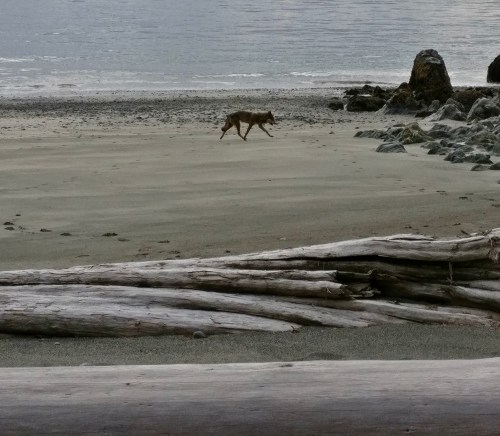
We had multiple encounters with bears and wolves, both employing our skills to be loud and obnoxious.  (the recommended approach when encountering a wolf is to stand together, make yourself look big, and stand your ground… which I what I did.  Gord on the other hand grabbed the camera)Version 2   Who needs bear spray when you have Ann who hasn’t washed her hair in 14 days?  (It had amazing body and I washed my head a couple times in the salt water).  No comment on Gord who wore the same merino shirt and johns day and night… except to say there are some pretty fine vinegar bacteria that we should have harvested before they, (Gord included),  were washed.    We even had a surprise encounter where we scared a bear who jumped up a tree… a massive Sitka Spruce… and we jumped to the left.  All three of us had our hearts racing.

What was so wow?

  • Cape Sutil food forest.  We won’t give many details other than to say we came across the most amazing First Nations’ 2000 yr old food forest complete with multiple varieties of crab apples, two species of salmon berry, thimble berry, salal, twin berry, black gooseberry, fireweed, giant vetch, silver weed, wild strawberry, huckleberry and evergreen huckleberry… and the list goes on.  The layers were amazing.  (Fascinating that white settlers had failed repeatedly at agriculture at Cape Scott while First Nations thrived at horticulture).   fullsizeoutput_cb3
  • Ann’s cooking!  (We think part of the reason our bodies thrived with the gruelling physical demands was the nutrient dense high quality foods we ate)
  • The real world.  (Spending 2 weeks in the REAL WORLD was very good for us)
  • The immense gratification and awe we had about how well our bodies were equipped to handle the tough terrain.   We even decided to test ourselves one day. (actually this was Gord’s idea and Ann got dragged along…I should have said no).   On a section of trail from Cape Sutil – Irony Creek – Laura Creek, which is a two day hike on what is classified as difficult terrain, we hiked two sections (19.5 kms) in a single day.   We won’t do that again.  After that hike we needed water, so we attempted to limp to the creek only to encounter a bear that couldn’t hear us due to the pounding waves.   The bear in the way, it took us 5 minutes of us yelling and banging pots to get him to notice us (100-150 ft away).   He finally lumbered peacefully into the forest.
  • Losing the track of days.  Yup, somewhere’s on the trip we lost track of the days, and thought we had an extra day to get back home.  (I never put my glasses on so I could not look at the device/camera to read the date… hence I had to rely on Gord).  We realized that the food was not adding up (we seemed to be a day short of food and were starting to ration it… and let me just say that Gord was going to have to be supervised around the remaining food).  Then looking at the date on the device (I insisted that Gord look at it and check the date), we realized our trek back to our truck from Lowrie Bay was no longer a two day process, but had to be a one day event – an 8 hour hike, then an 8 hour truck ride home…(the first two hours on a hot, dusty, busy logging road with a truck door that seemed ready to fall off…Gord assured me that it would not).  Epic day.
  • From Ann:  Thoroughly enjoyed my 2 weeks in the “Real World” completely immersed in the biological intensity of nature…however, it’s been tough coming back and adjusting to the human created industrial “civilized world”.A couple thoughts:

    * The things our culture focuses on just don’t seem very relevant…
    * The news of world issues, political instability and games/power struggles seem downright insane.
    * I fell even more deeply in love with nature and feel an even deeper sense of loss seeing the clear cuts of forest ALL THE WAY UP Vancouver Island. Angry!
    * 2 weeks with very limited material things showed me how little we actually need. Simplicity is beautiful and liberating!
    * Immense gratitude for simple things (like Gord).
    * Seeing how attempts at agriculture repeatedly failed in Cape Scott Park…yet First Nations practised forest gardening and lived regeneratively for many thousand years in this same area.
    * Death in nature creates MORE life. Mining, logging, and resource extraction creates actual DEATH.  


20045636_1526348454106968_2214654541524549796_o

Photo taken by Park Rangers near Cape Scott Lighthouse.  Our first contact with the outside world and they gave us an update on BC politics.


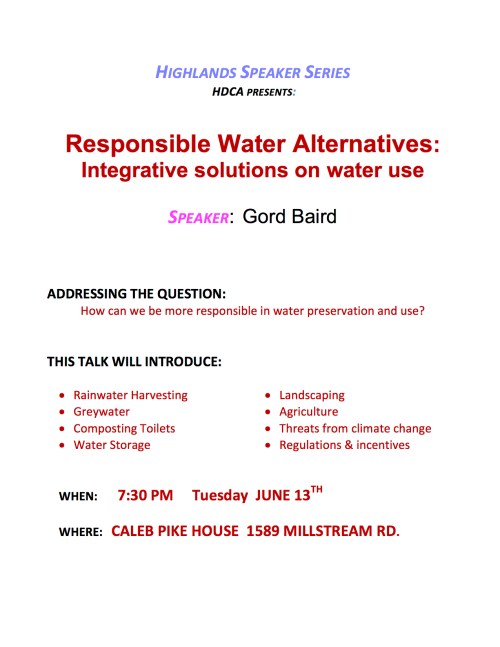
Short Notice – Water Presentation


On very short notice   –  for those wanting to attend Gord’s Presentation on Responsible Water Alternatives – in the Greater Victoria Area… open to the public and local.

HIGHLANDS JPEG


Beautiful and Stinky


The title “Beautiful and Stinky”, sums up our homestead right now.  The wet spring has lead to amazing growth and greenery with lots of fruit setting on our trees and shrubs.  The home made fish compost (like sea soil), has been distributed on our perennials adding to their health and nasty fragrance.  However, we much prefer stinky fish compost to toxic laundry smells or chemically scented shampoos, creams and lotions.

Nursery

The nursery at the end of a cold wet spring. Looking very green.

Last Day Of The Spring Season:  This Saturday, June 3rd from 10-3pm is the last day of the spring season to come on out to see and enjoy our beautiful and stinky homestead.  We are staying open an extra hour this Saturday.  3295 Compton Road, East Highlands, Victoria.

PLANT LIST: Check out our list of plants in stock and our prices.  Note that our prices include the GST.  Plant list.   BIG SALE:  Many items have been discounted AND everything is 10% off our list price.  

TOONIE TABLE – These items are priced to move:  Sweet potatoes slips, Oca starts, skirret plants, tomatillo starts (4 for $2), Heritage tomatoes.  Please give them a home.  $2 each.

In other news, we are getting REALLY excited about our upcoming backpacking adventure. It’s been 4 years since we’ve left the homestead.  We can’t deny that we do have anxiety about leaving our gardens, Nina, the ducks and chickens, and all the beauty and food here on this land.  However, we have two families living here while we embark on our backpacking trip of the North Coast Trail in Cape Scott Park.  This trip is keeping with our values of low carbon footprint nature immersion local holidays.  No flying for us!  We are also keeping our backpacking garbage to a minimum by making our own meals up with as much of our own local food as possible.  I have dried some veggies, fruit, and meat, made some low moisture hard cheese, and we are putting together our dried food meals.  We are planning a slower paced trip where we hike the trail both ways (rather than take a water taxi), and can stay a couple days in different locations when we are tired or just fall in love with the special places we will see.

Here’s some photo’s from our last trip together where we went kayaking to Brooks Peninsula:


Inappropriate Technology:  Dumping Telus moving to a different way of getting internet and phone – Gord is learning all about cable modems, ATAs, Routers, Switches, VOIP, and how to use a cell phone.  The system is up, the cellphone is set up with a voice mail to just email us… and our land line on a corded phone is now running over the internet.

IMG_20170602_110844

Connectedness reaching new levels

Appropriate Technology:  The solar dehydrator has reached new heights… now mounted upon a swivel pipe system for easy access and swiveling, better solar exposure, and less in the way.

IMG_20170602_110324

The dehydrator reaching new heights – now swivels: Today in the dryer we have 2 sheets of leeks, 1 dried hot cereal mixture, 3 kale chips, 1 raisons, 1 prunes.  We purchased raisons and prunes but are drying them further to reduce the weight for backpacking.

Natural tech reaches new heights:  Lushness is beginning and by late June it will be unbelievable.

IMG_20170602_110209

Lush